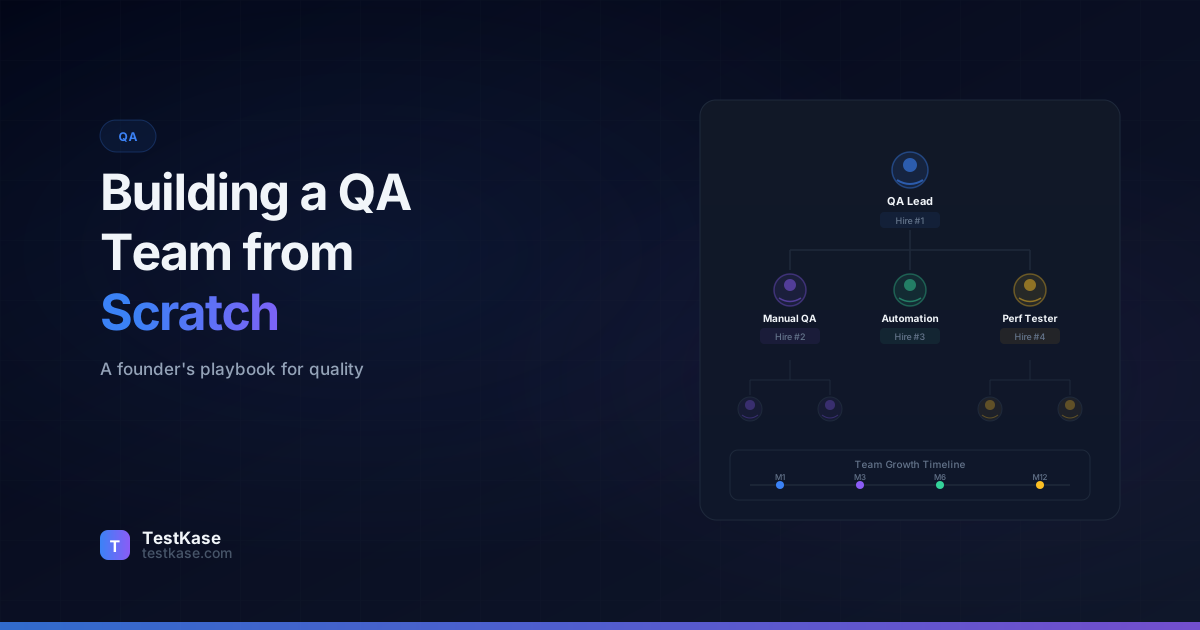
Building a QA Team from Scratch: A Founder's Playbook

Building a QA Team from Scratch: A Founder's Playbook
You've been shipping features at startup speed — developers writing code, doing a quick manual check, and pushing to production. It worked when you had three engineers and fifty users. But now you have twelve engineers, two thousand users, and a Slack channel called #prod-fires that lights up every Friday afternoon. Last month, a billing bug went unnoticed for nine days and cost you $14,000 in refunds and two enterprise contracts that were about to close.
You need QA. Not "everyone tests their own code" QA — a real, dedicated quality function. But you've never built one before. Do you hire a manual tester or an automation engineer? Should your first QA person write test plans or Selenium scripts? When do you need a QA lead versus individual contributors? How do you build processes without drowning in bureaucracy?
This playbook walks you through every stage — from your very first QA hire to scaling a team of twenty. It's based on patterns from dozens of startups that made this transition successfully, and the mistakes of those that didn't.
The Cost of Not Having QA
Before discussing how to build a QA team, let's quantify what you're losing without one. These numbers come from real startups that tracked their quality metrics before and after their first QA hire.
Direct financial costs. Production bugs cost 6-10x more to fix than bugs caught during development. For a SaaS startup processing $200K/month in transactions, a billing bug that persists for 9 days can mean $14K in refunds (as in our opening example), plus the hours developers spend on emergency fixes instead of feature work. The Consortium for IT Software Quality (CISQ) estimates that the average cost of a software failure in the US is $2.56 million per organization per year.
Opportunity costs. When developers spend 20-30% of their time on manual testing and production firefighting, that's 20-30% less time building features. For a 12-person engineering team averaging $150K fully-loaded cost per developer, that's $360K-540K annually in diverted engineering effort.
Customer trust erosion. According to a 2025 PwC survey, 32% of customers will leave a brand they love after one bad experience, and 59% will leave after several bad experiences. For a B2B SaaS product, each churned enterprise customer represents $30K-$200K in annual recurring revenue. Production bugs that affect workflows erode the trust that sales teams spent months building.
Sales impact. Enterprise buyers conduct security and reliability assessments before purchasing. A product with a visible pattern of production incidents — downtime pages, apologetic emails, data inconsistencies — fails these assessments. Two sales engineers at a Series B company reported that three deals worth a combined $480K were lost in a single quarter because prospects encountered bugs during their evaluation period.
The math is clear: a first QA hire at $120K-$160K fully loaded is one of the highest-ROI investments a growing startup can make.
When to Hire Your First QA Person
The temptation is to wait until the pain is unbearable. Don't. By the time production bugs are costing you customers, you've already been losing quality for months.
The Trigger Points
Hire your first QA person when any of these are true: your team has 6+ engineers, you're shipping to more than 500 users, you've had 3+ production incidents in a quarter caused by missed regressions, or developers are spending more than 20% of their time on manual testing instead of building features.
The most common mistake is waiting until you hit all four triggers simultaneously. By then, you've accumulated months of untested edge cases, zero regression coverage, and a team that's internalized "ship it and see what breaks" as culture. Rewiring that culture takes far longer than building QA processes from scratch.
A single QA person added at the right moment — around the 8-engineer mark — can dramatically change your defect escape rate. They won't catch everything, but they'll catch the embarrassing stuff: the broken signup flow, the payment form that doesn't validate credit card numbers, the password reset email that goes to the wrong address.
Here's a real timeline from a B2B SaaS startup that hired their first QA engineer at the 10-developer mark:
| Metric | Before QA hire | After 3 months | After 6 months | |--------|---------------|----------------|----------------| | Production incidents/month | 8-12 | 4-6 | 1-3 | | Customer-reported bugs/week | 15-20 | 5-8 | 2-4 | | Developer time on firefighting | 25-30% | 10-15% | 5-8% | | Release confidence (team survey) | 3/10 | 6/10 | 8/10 | | Average bug fix time | 4.2 days | 1.8 days | 0.9 days |
The before/after difference is dramatic, and the timeline to see results is shorter than most founders expect.
QA Engineer vs SDET vs QA Lead: Who to Hire First
Your first QA hire shapes everything that follows. Choose wrong, and you'll spend six months building an elaborate automation framework for a product whose UI changes weekly. Choose right, and you'll have someone who prevents fires while building the foundation for future scale.
For most startups at the 8-to-15-engineer stage, hire a senior QA engineer with some automation skills — not a pure manual tester, not a pure automation engineer. You want someone who can write test cases, run exploratory sessions, define processes, AND set up basic automation for your critical paths. This person becomes your QA foundation.
The job title matters less than the skill mix. Look for someone who has:
- Written test plans and managed test cases in at least one tool
- Set up basic automation (even just API tests with Postman or a few Cypress tests)
- Worked in a startup or early-stage environment where process was being built, not followed
- Strong communication skills — your first QA person will spend 40% of their time talking to developers and product managers
- Experience saying "no" to process bloat — you want someone who builds light, not heavy
Avoid hiring someone whose entire career has been at large enterprises with established QA processes. They'll try to implement heavyweight processes that don't fit a team of twelve. Specifically, watch for candidates who talk about "comprehensive test strategies" and "governance frameworks" in their first 30 days. You need someone who talks about finding the most critical bugs as fast as possible.
The First 90 Days: What Your First QA Hire Should Accomplish
Set clear expectations with your first QA hire about what success looks like:
Days 1-30: Understand and Stabilize
- Learn the product by using it as a customer would (not by reading documentation)
- Identify the top 10 most critical user flows
- Map the existing bug landscape — what's in the backlog, what's being reported by customers
- Create a simple smoke test checklist for the critical flows
- Establish a bug reporting template
Days 31-60: Build Foundations
- Write test cases for the top 10 critical flows
- Set up 5-10 automated tests for the most stable critical paths
- Define a bug triage cadence with engineering and product
- Create an onboarding document for the product's QA context
- Start tracking production incident rate as a baseline metric
Days 61-90: Optimize and Scale
- Expand test coverage to the next tier of important features
- Integrate automated tests into CI/CD pipeline
- Produce the first "quality report" for the engineering team
- Recommend next QA hire timing and profile based on observed gaps
- Propose process improvements based on what they've learned
Interview Questions That Actually Work
Standard QA interview questions — "What's the difference between verification and validation?" — tell you almost nothing about whether someone can build QA from scratch. Here are questions that reveal the skills you actually need:
"Describe a time you joined a team with no QA process. What did you do in the first 30 days?" This reveals whether they've built from zero or only operated within existing structures. You want specifics: "I mapped the critical user flows, identified the three highest-risk areas, wrote smoke test cases, and set up a shared spreadsheet for tracking" beats "I implemented a comprehensive quality strategy" every time.
Red flags in answers: Vague strategy talk without concrete actions. Mentioning tools before processes. Suggesting you need three months before anything improves.
"Here's our product [show them a demo]. You have one hour to test it. Walk me through your approach." Give them a real session. Watch how they prioritize, what they test first, whether they ask clarifying questions, and how they document what they find. Great QA people find real bugs during interviews.
What to look for: Do they start with the most impactful features (signup, core workflow, payment) or test randomly? Do they ask about the user base and business context? Do they note severity when they find issues? Do they test edge cases instinctively (special characters, empty fields, boundary values)?
"Our developers push code to production four times a day. How do you keep up?" This tests their understanding of modern development velocity. Anyone who answers with "slow down deployments" or "require sign-off on every release" is going to create friction. You want someone who talks about automated smoke tests, risk-based testing, and targeted manual checks.
"What would you NOT test?" This is the most revealing question. Junior QA people say "test everything." Senior QA people say "I wouldn't test the third-party payment widget's internal validation because that's Stripe's responsibility — I'd test our integration with it." Knowing what to skip is a sign of maturity.
"Tell me about a bug that escaped to production on your watch. What happened and what did you change?" This tests self-awareness and learning ability. Everyone ships bugs — the question is whether they learn from it. Look for specific process changes they implemented, not just "I'll be more careful next time."
"How would you convince a developer that a bug they consider 'low priority' is actually worth fixing?" This tests communication and influence skills, which are critical for a sole QA engineer who needs to advocate for quality without positional authority.
Defining QA Processes Without Creating Bureaucracy
Your first QA processes should fit on a single page. Seriously. If your QA process document is longer than one page in the first six months, you've over-engineered it.
Start with three processes and nothing else:
1. Bug reporting standard. Define what a bug report must contain: steps to reproduce, expected vs actual behavior, environment, severity, and a screenshot or video. Make developers follow the same format when they report bugs. This single standard eliminates 80% of "I can't reproduce this" back-and-forth.
Here's a minimal bug report template that works:
## Bug Report Template

**Title:** [Severity] Brief description of the issue
**Environment:** [Production / Staging / Local] — Browser, OS
**Steps to Reproduce:**
1. Go to [URL]
2. Do [action]
3. Observe [result]

**Expected:** What should happen
**Actual:** What actually happens
**Severity:** Critical / High / Medium / Low
**Screenshot/Video:** [Attach]
**Notes:** Any additional context, related issues, or workarounds
2. Smoke test checklist. A list of 10-15 critical user flows that get checked before every release. Login, signup, core workflow, payment — the things that, if broken, would make the front page of Hacker News. This checklist should take 30-45 minutes to run manually.
Example smoke test checklist for a B2B SaaS product:
## Pre-Release Smoke Test (Target: 30 minutes)

### Authentication (5 min)
- [ ] Sign up with new email
- [ ] Log in with existing credentials
- [ ] Reset password flow works

### Core Workflow (10 min)
- [ ] Create a new [primary entity]
- [ ] Edit an existing [primary entity]
- [ ] Delete and confirm [primary entity] removed
- [ ] Search returns relevant results

### Billing (5 min)
- [ ] View current subscription plan
- [ ] Upgrade plan (use test card 4242...)
- [ ] Apply discount code

### Integrations (5 min)
- [ ] Jira sync creates ticket correctly
- [ ] Email notifications arrive
- [ ] Webhook fires on [trigger event]

### Data (5 min)
- [ ] CSV export downloads correctly
- [ ] Import file processes without errors
- [ ] Dashboard loads within 5 seconds
3. Bug triage cadence. A 15-minute meeting twice a week where QA, engineering lead, and product decide which bugs to fix now, which to defer, and which to close. Without this, your bug backlog grows unchecked and eventually everyone stops looking at it.
The triage meeting has a simple structure:
- Review new bugs since last triage (2 minutes per bug max)
- Assign priority and sprint for each (fix now, fix next sprint, backlog, won't fix)
- Review any bugs that have been in "assigned" state for more than one sprint
The One-Page Rule
Write your entire QA process on one page. If it doesn't fit, you're adding process for process's sake. Expand only when the current process provably fails — not when someone thinks "we should probably also do X." Process adoption beats process comprehensiveness every time.
That's it for month one. Don't add test plans, test cycles, automation frameworks, or coverage metrics until your team has internalized these three basics. Process adoption beats process comprehensiveness every time.
Choosing Your Initial Tools
Your first QA tool stack should be minimal. You need three things: a place to write test cases, a place to track bugs, and a place to communicate.
For bug tracking, use whatever your engineering team already uses — Jira, Linear, GitHub Issues. Don't introduce a separate bug tracking tool. QA bugs should live in the same backlog as feature work so they compete for priority transparently.
For test case management, you have two options. Some teams start with spreadsheets — Google Sheets with columns for test name, steps, expected result, status. This works for about three months, until you have 200 test cases and can't track which ones were run in which release. At that point, move to a proper test management tool that supports folders, test cycles, and history.
The spreadsheet-to-tool migration typically happens when you experience one or more of these symptoms:
- You can't answer "which test cases did we run for the v2.3 release?"
- Multiple people are editing the spreadsheet simultaneously and overwriting each other
- You need to track pass/fail history over time, not just current state
- Your test case count exceeds 150-200 and the spreadsheet becomes unwieldy
- You need to generate reports for stakeholders
For communication, your existing Slack or Teams setup works. Create a #qa channel. Post daily summaries of what was tested, what bugs were found, and what's blocked. This visibility is more valuable than any dashboard in the early days.
Tool Stack by Stage
| Stage | Bug Tracking | Test Management | Automation | Communication | |-------|-------------|-----------------|------------|---------------| | Pre-QA hire | GitHub Issues | None | Developer unit tests | #engineering Slack | | First QA hire | Jira / Linear | Spreadsheet → TestKase | Cypress (5-15 tests) | #qa Slack channel | | 3-5 QA team | Jira with workflows | TestKase with folders | Cypress + API tests | #qa + #qa-automation | | 10-20 QA team | Jira with custom fields | TestKase with dashboards | Full framework + CI/CD | Multiple QA channels |
Don't buy expensive tools upfront. Start lean, identify pain points, then invest in tools that solve specific problems you've actually experienced.
Building a Testing Culture
Tools and processes are useless without culture. Building a testing culture means making quality everyone's responsibility — not just the QA team's problem.
Make QA part of sprint planning. QA shouldn't hear about features for the first time when they land in a staging environment. Include your QA person in planning sessions so they can ask questions, identify risks, and start writing test cases before development begins.
The impact of early QA involvement is significant. A 2025 Capgemini World Quality Report found that teams with QA involved in requirements and design phases detect 3x more defects before development, reducing total defect cost by 40-60%.
In practice, this means your QA engineer reviews every user story before it enters the sprint and adds:
- Acceptance criteria clarifications (edge cases the product manager didn't consider)
- Test approach notes (how they'll verify this feature)
- Risk flags (dependencies, integration points, historical problem areas)
Celebrate bug finds, not bug counts. When QA catches a critical bug before release, call it out publicly. "Alex found a data corruption bug in the export feature that would have affected every enterprise customer" is the kind of recognition that reinforces quality culture. Never celebrate raw bug counts — that incentivizes finding trivial issues.
Developers write unit tests, QA writes integration tests. Draw a clear line. Developers own unit-level verification. QA owns end-to-end flows and cross-feature integration. This division prevents both gaps and overlap.
The testing pyramid for a startup typically looks like:
            /  \
           / E2E\       ← QA owns: 10-20 critical path tests
          /______\
         /        \
        /Integration\    ← Shared: QA designs, devs may implement
       /______________\
      /                \
     /   Unit Tests     \  ← Developers own: 200-500+ tests
    /____________________\
Blameless post-mortems for production bugs. When bugs escape to production, do a quick retro: why didn't we catch it? Was it a gap in test coverage? A missing test case? An environment difference? These retros build the institutional knowledge that prevents repeat escapes.
A lightweight post-mortem template:
## Production Bug Post-Mortem

**Bug:** [Brief description]
**Impact:** [Users affected, duration, financial cost]
**Root cause:** [What went wrong technically]
**Why we missed it:**
- [ ] No test case existed for this scenario
- [ ] Test case existed but wasn't in the regression suite
- [ ] Environment difference between staging and production
- [ ] Edge case that requires specific data conditions
- [ ] Third-party integration behavior changed
- [ ] Other: ___

**Action items:**
1. [Specific test case to add]
2. [Process change if needed]
3. [Monitoring to add]
Create a "quality score" for releases. Give every release a simple quality score based on: smoke tests passed, regression tests passed, open critical/high bugs, and customer-reported bugs within 48 hours of release. Track this score over time. When the team can see quality trends visually, they naturally invest more in preventing regressions.
Scaling from 1 to 5 to 20
Your QA team's structure should evolve with your product and engineering team.
1 QA person (8-15 engineers): They do everything — manual testing, test case management, basic automation, process definition, bug triage. They're embedded with the engineering team, not separate from it.
Key success factors at this stage:
- QA person attends all engineering standups and sprint planning
- They have direct access to all developers (no intermediaries)
- They own the decision of what to test and what to skip
- They report to the engineering manager, not a separate QA org
3-5 QA people (15-40 engineers): Specialize. One or two people focus on automation — building frameworks, writing regression suites, integrating with CI. The others focus on manual testing and exploratory work, each aligned to a product area. You need a QA lead at this stage, even if it's one of the existing QA engineers who takes on coordination.
At this stage, introduce:
- Formal test cycles tied to releases
- Code review for test automation (same standards as production code)
- Quarterly test case review to prune obsolete tests
- QA metrics dashboard (defect escape rate, cycle time, coverage)
10-20 QA people (40-100+ engineers): Organize by product domain. Each product squad has an embedded QA engineer. A central QA platform team maintains shared automation frameworks, test infrastructure, and reporting dashboards. The QA lead becomes a QA manager with hiring and budget responsibility.
At this stage, add:
- Dedicated QA platform/infrastructure team (2-3 people)
- Performance and security testing capabilities
- Test data management strategy
- Cross-team regression coordination
- Formal QA career ladder (IC and management tracks)
Don't Skip the Middle Stage
Many companies try to jump from 1 QA person to 10. This always fails. The first QA person built processes that work for one person. Those processes break at 10. You need the 3-5 person stage to evolve processes, build automation foundations, and develop QA leadership before scaling further. Budget 6-12 months at each stage before growing to the next.
The QA Hiring Pipeline
Finding good QA engineers is harder than most founders expect. Here's a realistic pipeline:
Where to source candidates:
- QA-specific communities: Ministry of Testing, QA subreddits, testing conferences
- Internal referrals from your engineering team (developers often know good testers)
- LinkedIn with targeted searches: "QA engineer" + "startup" or "early stage"
- Bootcamp graduates who pivoted to QA (often have fresh automation skills)
What your job posting should emphasize:
- Impact: "You'll be our first QA hire, defining quality for the entire product"
- Autonomy: "You'll own the testing strategy, not execute someone else's plan"
- Growth: "Build and lead the QA team as we scale"
- Avoid: "5+ years of enterprise testing experience required" (this filters out the startup-minded candidates you want)
Compensation benchmarks (2026, US):
- First QA hire (senior generalist): $120K-$160K base + equity
- SDET: $130K-$175K base + equity
- QA Lead: $150K-$190K base + equity
- QA Manager: $170K-$210K base + equity
Equity matters more than at larger companies because your first QA hire is taking a risk on a young team. Offer meaningful equity — 0.1-0.3% for an early-stage hire — to attract candidates who could earn more at a larger company.
Common Founder Mistakes
Hiring QA too late. Waiting until you have 30 engineers and a broken product means your first QA hire walks into a nightmare. They spend their entire first quarter just cataloging existing bugs instead of preventing new ones. Worse, the culture of "ship without testing" is deeply entrenched by this point and takes months to change.
Treating QA as a gate. If developers can't ship until QA "approves," you've created a bottleneck that will slow your entire engineering org. QA should inform release decisions, not block them unilaterally. The right model: QA provides a quality assessment, and the engineering lead or product manager makes the ship decision with that data.
Measuring QA by bugs found. If your QA team's performance metric is "number of bugs found," they'll find hundreds of trivial cosmetic issues and miss the one critical logic error. Measure defect escape rate instead — how many bugs reach production? That's the metric that matters.
Better QA metrics for startups:
- Defect escape rate: Percentage of bugs found in production vs. pre-production
- Mean time to detect: How quickly bugs are found after introduction
- Release confidence score: Team's self-reported confidence in each release
- Regression rate: How often previously fixed bugs reappear
Separating QA from engineering. QA should sit with developers, attend the same standups, and use the same tools. Separate QA departments create us-vs-them dynamics that slow everything down. The moment developers start saying "that's QA's problem" is the moment your quality culture has failed.
Not investing in QA tools. Spreadsheets stop working at scale. A proper test management platform pays for itself within months through saved time and better visibility. The ROI math: if your QA team spends 5 hours/week on spreadsheet management that a tool would reduce to 1 hour, that's 200+ hours/year saved. At a QA engineer's hourly rate, the tool pays for itself in the first month.
Hiring a QA manager before you have QA engineers. A manager with nobody to manage will either become an expensive individual contributor (overpaid for the role) or spend months building elaborate processes and frameworks that the future team may not need. Hire ICs first, promote one to lead when you have 3-5, and hire a manager only when you're growing beyond 8-10.
How TestKase Supports Growing QA Teams
TestKase is designed to grow with your QA team — from your first hire to your twentieth. Start with simple test case management: organize cases in folders, run them through test cycles, track results. As your team grows, add automation result ingestion, Jira integration for seamless bug tracking, and AI-powered test case generation to accelerate coverage.
The platform supports the exact scaling path described above. One QA person can manage test cases and cycles without overhead. A team of five can use shared folders, role-based access, and parallel test cycles across product areas. A team of twenty gets dashboards, trend reporting, and integration APIs that connect to your CI/CD pipeline.
You shouldn't have to switch tools as you scale. TestKase is built so you don't have to.
Start Free with TestKaseConclusion
Building a QA team from scratch is one of the highest-leverage investments a growing startup can make. The data is clear: companies that invest in QA at the right time ship faster, retain more customers, and close more enterprise deals than those that bolt it on later.
Hire your first QA person around the 8-engineer mark — a senior generalist who can test, automate, and define process. Start with three simple processes that fit on one page. Choose minimal tools and upgrade as you hit real pain points. Build a culture where quality is everyone's job, not just QA's. Scale deliberately through the 1-to-5-to-20 stages without skipping steps.
The companies that get QA right early ship faster and more confidently than those that bolt it on later. Start now, start small, and build systematically. Your future self — and your customers — will thank you.
Stay up to date with TestKase
Get the latest articles on test management, QA best practices, and product updates delivered to your inbox.
SubscribeShare this article
Related Articles
Critical, Serious, Moderate, Minor: How to Triage Accessibility Issues by Severity
A practical triage policy template — SLAs per severity, ownership across design / engineering / content / QA, and how to share findings cross-team without forwarding PDFs.
Read more →Why Single-Page Accessibility Scans Miss Real Bugs (and What Multi-Page Audits Catch)
Single-URL accessibility scanners miss six entire categories of WCAG violations. Here's what falls through the gap, and how flow-aware audits catch the issues your users actually hit.
Read more →Accessibility Testing in CI/CD: Catching WCAG Issues Before They Ship
Three integration patterns, GitHub Actions / GitLab / CircleCI templates, and a 3-quarter rollout playbook to take an engineering team from zero accessibility in CI to block-on-fail.
Read more →