From a requirement to the bug it caught, in one line
Write requirements and test cases, run them in cycles, and file the defects — each one linked to the next, so coverage is a lookup instead of an argument.
Free for up to 3 users · no card required · 37 reports on every plan
- RequirementREQ-42
Guest can complete checkout
- Test cases3 cases · v4
Happy path, guest, empty cart
- Run · Cycle 12staging2 pass 1 fail
- Defect→ Jira
Tax missing on an empty cart
“400 tests passed” still doesn't say what's covered
A pass count measures activity, not coverage. Ask whether a feature is tested and the answer is a hunt through spreadsheets and memory — and the one requirement with no tests is the one nobody finds until it ships.
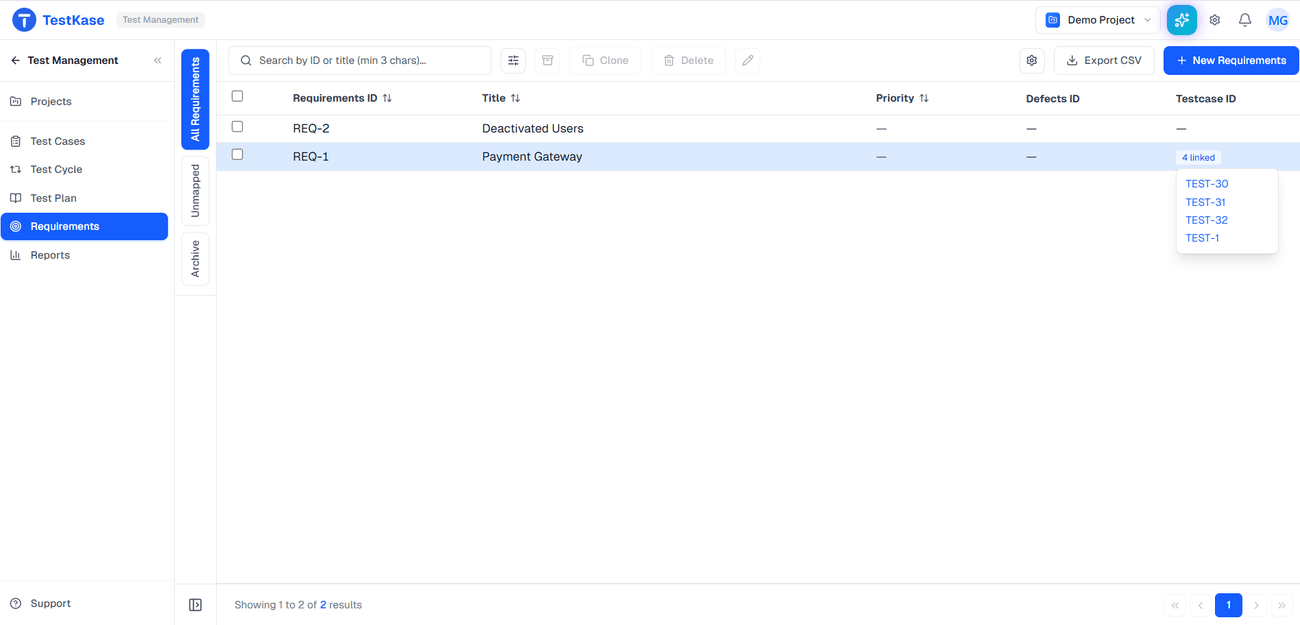
Every part of a test run, connected
Not six tools bolted together — one chain, where each object links to the next.
Requirements
Keep them here, or link from Jira, GitHub or GitLab.
Test cases
Steps, expected results, custom fields and version history.
Test cycles
Pick cases, assign them, set the environment, watch results land.
Defects
File to nine trackers or the built-in one, linked to the test that found it.
Reports
37 reports on every plan, plus 11 insights read from your own history.
Traceability
Every result records the exact version of the case that ran.
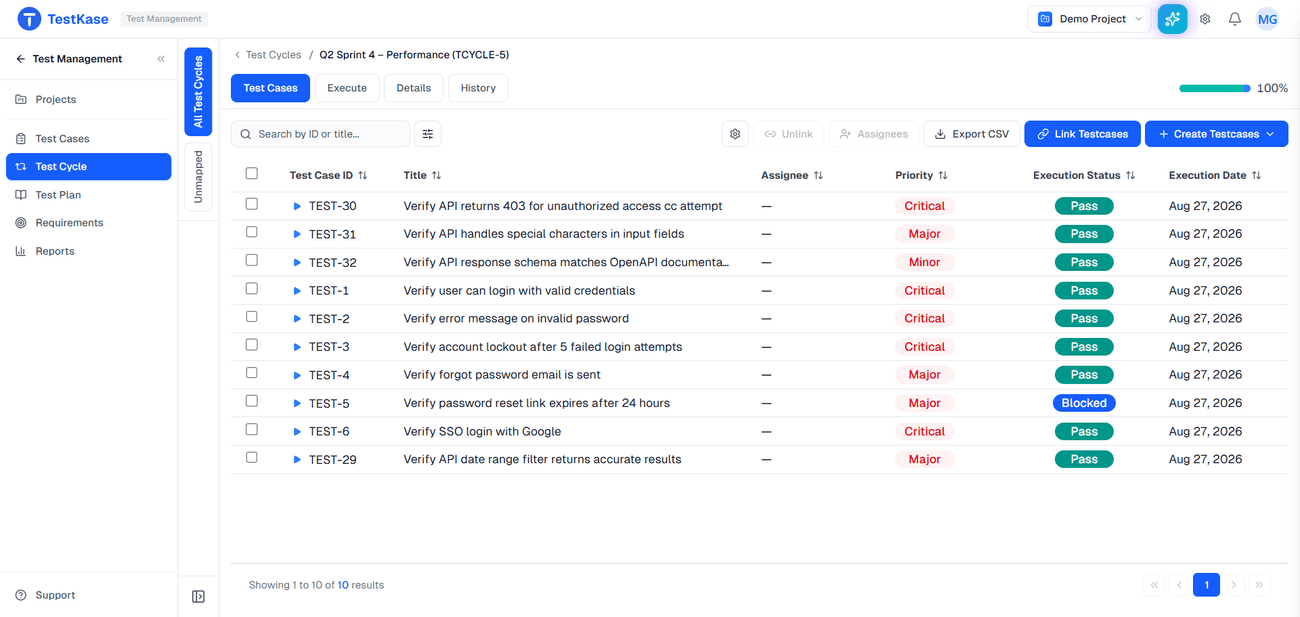
A green tick that still means something in six months
Pick the cases, assign them, set the environment, and watch the results land. Each one records who ran it and which version of the case they ran — so an old result reads honestly even after the case has changed.
Free for up to 3 users
No card and no trial clock, with 3 GB of storage for the whole organisation.
37 reports on every plan
Including 11 insights that read your own history and use no AI credits.
Anyone can file a defect
No per-seat cost, so the person who finds a bug is the one who reports it.
Frequently asked questions
Yes — up to 3 users with no card and no trial clock. You get the requirements, test cases, cycles, defects and reports, plus 3 GB of storage for the organisation. Paid plans add more seats and per-user storage.
No. Requirements, test cases and defects are real objects in TestKase, so a team with no tracker can start straight away. If you already keep requirements in Jira, GitHub or GitLab, link to them instead of copying them.
Nine destinations: Jira, GitHub, GitLab, Asana, Trello, ClickUp, Monday, Azure Boards, and TestKase's own built-in tracker. Each has a real implementation — if it is listed, an issue raised from a test result appears in it. Anyone in the workspace can file, with no per-seat cost.
No. The 11 insight reports are pure SQL and heuristics over your own execution history — flaky tests, stale cases, release risk and more. They use no AI credits and work on the free plan.
Yes. Every execution records the version of the test case it ran, along with who ran it and the environment — so an old result still reads honestly after the case has been edited.
No — requirements are not versioned, though test cases and test cycles do carry version history. If your process needs to prove what a requirement said on a given date, keep it in a tracker that records that and link to it.
Not yet. You can capture and attach an image, but drawing arrows or boxes on it happens in whatever tool you already use.
No. An issue filed into an external tracker is owned by that tracker; its status is not mirrored back here, which keeps the two systems from disagreeing about who owns the truth.
Up to 50 MB on a test case, requirement or defect.
See which requirements have no tests
It is a shorter list than you expect — and the one thing a pass count can never tell you.