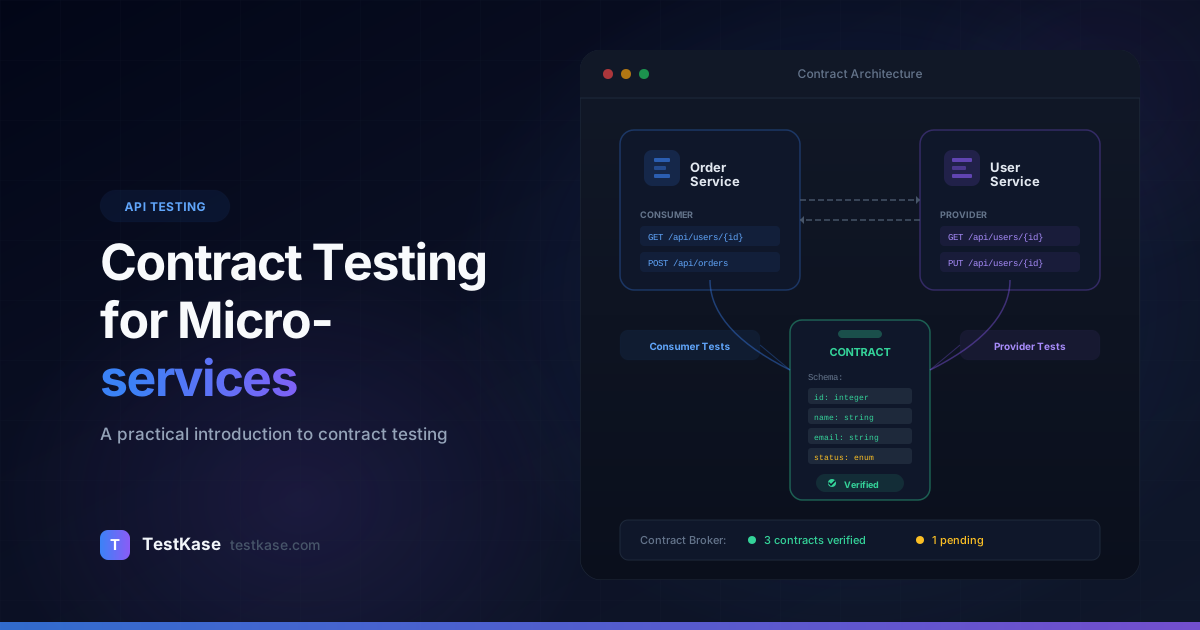
Contract Testing for Microservices: A Practical Introduction

Contract Testing for Microservices: A Practical Introduction
Your team ships a change to the Orders service on Tuesday. By Wednesday morning, the Payments service is broken in production. Nobody changed Payments. Nobody touched the shared database. But the Orders service started returning orderTotal as a string instead of a number — and Payments couldn't parse it.
This scenario plays out constantly in microservices architectures. A 2024 survey by Postman found that 58% of API-related production incidents stem from breaking changes that weren't caught before deployment. Integration tests should catch these problems, right? In theory, yes. In practice, they're slow, flaky, and nearly impossible to keep in sync across dozens of independently deployed services.
Contract testing offers a fundamentally different approach. Instead of spinning up every service to test them together, you define a "contract" between each pair of services — a formal agreement about what requests look like and what responses contain. Each service tests against the contract independently, and you find out about breaking changes before they ever reach production.
This guide walks you through the full contract testing lifecycle: why integration tests struggle at scale, how consumer-driven contracts work, hands-on Pact implementation in multiple languages, CI/CD integration patterns, and the real-world pitfalls teams encounter when rolling out contract testing across a growing microservices architecture.
Why Integration Tests Fall Short for Microservices
Integration tests were designed for monoliths — environments where you could spin up the entire application, run tests, and get a definitive answer about whether things worked. Microservices shatter that model.
The integration test problem at scale
A system with 15 microservices has up to 210 possible pairwise interactions. Testing every combination in an integration environment requires all 15 services running simultaneously — each with its own database, configuration, and dependencies. Most teams give up and test only the "critical paths," leaving gaps everywhere.
Here's what goes wrong with integration tests in microservices:
- Environment instability — Getting 10+ services running simultaneously is fragile. One broken deployment blocks everyone.
- Slow feedback — End-to-end integration suites often take 30–60 minutes. Developers stop waiting and merge anyway.
- Ownership conflicts — When an integration test fails, who fixes it? The team that changed their service, or the team whose test broke?
- Version mismatch — The integration environment rarely runs the exact combination of service versions that will be deployed to production.
- Cost — Maintaining dedicated integration environments with all dependencies is expensive — both in infrastructure and engineering time.
Consider a real-world example. A fintech company running 40+ microservices reported spending $18,000/month on AWS resources just for their integration testing environments. Each environment spun up full copies of every service, every database, and every message queue. Despite this investment, their integration test suite only covered 35% of service-to-service interactions — and it failed intermittently 20% of the time due to timing issues and stale data.
Contract testing doesn't replace integration tests entirely, but it eliminates the need for integration tests whose sole purpose is verifying that services can still talk to each other. When teams adopt contract testing for communication verification and reserve integration tests for business-critical end-to-end flows, they typically reduce environment costs by 40–60% while improving defect detection rates.
What Is Contract Testing?
Contract testing verifies that two services can communicate by checking each side against a shared contract — without requiring both services to be running at the same time.
Think of it like a legal contract between a buyer and a seller. The buyer (consumer) says, "I expect the product to meet these specifications." The seller (provider) says, "I agree to deliver a product that meets those specifications." Neither party needs to be in the same room to verify compliance — they just need the contract.
In software terms:
- Consumer: The service making the API request (e.g., a frontend or another microservice)
- Provider: The service handling the request and returning a response
- Contract: A machine-readable document specifying request format, response structure, status codes, and data types
There are two main approaches to contract testing:
Consumer-driven contracts (CDC) are the most popular approach, and the one we'll focus on here. The fundamental insight behind CDC is that consumers know best what they need from a provider — and if the provider satisfies every consumer's needs, the system works.
Why Consumer-Driven Contracts Win in Practice
Provider-driven contracts sound reasonable: the provider publishes its API spec, and consumers conform to it. But this approach has a critical weakness — it doesn't tell the provider which parts of its API are actually used.
A provider might have 40 endpoints, but a specific consumer only uses 3 of them. A provider-driven contract protects all 40, creating unnecessary coupling. Consumer-driven contracts only protect what each consumer actually depends on. If the provider changes an endpoint that no consumer uses, the contract tests still pass — which is exactly the right outcome.
This distinction matters for large organizations. When a provider team needs to evolve their API, CDC testing tells them precisely which consumers will be affected by each change. They can coordinate migrations with just the affected teams instead of broadcasting changes to everyone.
Consumer-Driven Contracts: How They Work
In CDC testing, the consumer writes the contract. The flow looks like this:
Step 1: Consumer writes a test. The consumer team writes a test that describes the HTTP request it will make and the response it expects. This test runs against a mock server — no real provider needed.
Step 2: A contract (pact) is generated. When the consumer test passes, a contract file is generated — typically a JSON document describing the interaction.
Step 3: Provider verifies the contract. The provider team runs the contract against their actual service. If the provider returns responses matching the contract, verification passes. If not, the provider knows they're about to break a consumer.
Step 4: Contracts are versioned and shared. Contracts are stored in a central location (like a Pact Broker) so both sides always test against the latest version.
Here's a simplified consumer test using the Pact framework in JavaScript:
const { Pact } = require('@pact-foundation/pact');

const provider = new Pact({
  consumer: 'PaymentService',
  provider: 'OrderService',
  port: 1234,
});

describe('Order API Contract', () => {
  beforeAll(() => provider.setup());
  afterAll(() => provider.finalize());

  it('returns order details', async () => {
    await provider.addInteraction({
      state: 'an order with ID 42 exists',
      uponReceiving: 'a request for order 42',
      withRequest: {
        method: 'GET',
        path: '/orders/42',
        headers: { Accept: 'application/json' },
      },
      willRespondWith: {
        status: 200,
        headers: { 'Content-Type': 'application/json' },
        body: {
          id: 42,
          orderTotal: Matchers.decimal(99.99),
          status: Matchers.like('confirmed'),
          items: Matchers.eachLike({ productId: 1, quantity: 2 }),
        },
      },
    });

    // Make the actual HTTP call your service would make
    const response = await fetchOrder(42);
    expect(response.status).toBe(200);
    expect(response.data.orderTotal).toBeGreaterThan(0);
  });
});
Notice the Matchers — Pact doesn't require exact values. It uses matchers like decimal(), like(), and eachLike() to verify the shape and type of the response, not specific data. This makes contracts flexible enough to handle real-world variation.
Testing Multiple Interactions
Real consumer-provider relationships involve more than one API call. A consumer test should cover all the interactions it depends on, including error scenarios:
describe('Order API Contract - Error Handling', () => {
  it('returns 404 for non-existent order', async () => {
    await provider.addInteraction({
      state: 'no order with ID 999 exists',
      uponReceiving: 'a request for non-existent order 999',
      withRequest: {
        method: 'GET',
        path: '/orders/999',
        headers: { Accept: 'application/json' },
      },
      willRespondWith: {
        status: 404,
        body: {
          error: Matchers.like('Order not found'),
          code: Matchers.like('ORDER_NOT_FOUND'),
        },
      },
    });

    const response = await fetchOrder(999);
    expect(response.status).toBe(404);
  });

  it('returns 400 for invalid order creation', async () => {
    await provider.addInteraction({
      state: 'the order service is running',
      uponReceiving: 'a request to create an order with missing fields',
      withRequest: {
        method: 'POST',
        path: '/orders',
        headers: { 'Content-Type': 'application/json' },
        body: { items: [] },
      },
      willRespondWith: {
        status: 400,
        body: {
          errors: Matchers.eachLike({
            field: Matchers.like('items'),
            message: Matchers.like('must not be empty'),
          }),
        },
      },
    });

    const response = await createOrder({ items: [] });
    expect(response.status).toBe(400);
  });
});
Testing error scenarios in contracts is just as important as testing happy paths. If the consumer expects a specific error response format and the provider changes it, the consumer's error handling logic will break silently.
The Pact Framework: A Closer Look
Pact is the most widely adopted contract testing framework. It supports JavaScript, Java, Python, Go, Ruby, .NET, and more — which matters because microservices often use different languages.
Start with one critical integration
Don't try to add contract tests for every service interaction at once. Pick the integration that breaks most often or causes the most production incidents. Get that working first, then expand.
Key Pact concepts:
- Pact file: The JSON contract generated from consumer tests. Contains interactions — each with a request and expected response.
- Provider states: A way to tell the provider, "Before you verify this interaction, set up this precondition." For example, "an order with ID 42 exists" tells the provider to seed its database with that order.
- Matchers: Type-based matching (
like), array matching (eachLike), regex matching (term), and numeric matching (integer,decimal). Use matchers instead of exact values to make contracts resilient. - Pact Broker: A central service that stores contracts, tracks verification results, and determines whether a particular combination of service versions is safe to deploy.
Provider verification looks like this (Java example):
@Provider("OrderService")
@PactBroker(host = "pact-broker.internal", port = "443", scheme = "https")
public class OrderProviderContractTest {

    @TestTarget
    public final Target target = new HttpTarget("localhost", 8080);

    @State("an order with ID 42 exists")
    public void setupOrder42() {
        orderRepository.save(new Order(42, BigDecimal.valueOf(99.99), "confirmed"));
    }

    @State("no order with ID 999 exists")
    public void setupNoOrder999() {
        orderRepository.deleteById(999);
    }

    @State("the order service is running")
    public void ensureServiceRunning() {
        // No specific setup needed — just ensure the service is up
    }
}
The provider test fetches the contract from the Pact Broker, makes the specified request against the real provider service, and checks whether the actual response matches the contract. No consumer service is involved.
Pact in Python
For teams using Python microservices, Pact provides a Python client as well. Here's a consumer test example using pact-python:
import atexit
import unittest
from pact import Consumer, Provider

pact = Consumer('PaymentService').has_pact_with(
    Provider('OrderService'),
    port=1234,
    pact_dir='./pacts'
)
pact.start_service()
atexit.register(pact.stop_service)

class OrderContractTest(unittest.TestCase):

    def test_get_order(self):
        expected = {
            'id': 42,
            'orderTotal': 99.99,
            'status': 'confirmed'
        }

        (pact
         .given('an order with ID 42 exists')
         .upon_receiving('a request for order 42')
         .with_request('GET', '/orders/42')
         .will_respond_with(200, body=expected))

        with pact:
            result = fetch_order(42)
            self.assertEqual(result['id'], 42)
            self.assertIsInstance(result['orderTotal'], float)
The polyglot support is particularly valuable because the consumer and provider can be written in entirely different languages — a JavaScript frontend consuming a Python API, for instance — and the contract acts as the language-agnostic bridge.
Integrating Contract Tests into CI/CD
Contract testing delivers its full value when integrated into your CI/CD pipeline. The typical workflow:
- Consumer CI pipeline: Run consumer contract tests. If they pass, publish the new pact to the Pact Broker.
- Provider CI pipeline: After publishing, trigger the provider pipeline (via webhook or scheduled job). The provider verifies against all consumer contracts.
- Can-I-Deploy check: Before deploying any service, query the Pact Broker: "Can I deploy version X of OrderService to production?" The broker checks whether all contracts involving that version have been verified successfully.
# Check if it's safe to deploy OrderService v1.2.3
pact-broker can-i-deploy \
  --pacticipant OrderService \
  --version 1.2.3 \
  --to-environment production
This single command replaces hours of manual integration testing. If any consumer contract hasn't been verified against this version, deployment is blocked automatically.
GitHub Actions Example
Here's a concrete CI workflow for a consumer service using GitHub Actions:
name: Consumer Contract Tests

on:
  push:
    branches: [main]
  pull_request:
    branches: [main]

jobs:
  contract-test:
    runs-on: ubuntu-latest
    steps:
      - uses: actions/checkout@v4

      - name: Install dependencies
        run: npm ci

      - name: Run consumer contract tests
        run: npm run test:contract

      - name: Publish pact to broker
        if: github.ref == 'refs/heads/main'
        run: |
          npx pact-broker publish ./pacts \
            --consumer-app-version=${{ github.sha }} \
            --branch=${{ github.ref_name }} \
            --broker-base-url=${{ secrets.PACT_BROKER_URL }} \
            --broker-token=${{ secrets.PACT_BROKER_TOKEN }}

      - name: Check deployment safety
        if: github.ref == 'refs/heads/main'
        run: |
          npx pact-broker can-i-deploy \
            --pacticipant PaymentService \
            --version=${{ github.sha }} \
            --to-environment production \
            --broker-base-url=${{ secrets.PACT_BROKER_URL }} \
            --broker-token=${{ secrets.PACT_BROKER_TOKEN }}
The can-i-deploy step acts as a deployment gate — if any provider hasn't verified against this consumer's latest contract, the pipeline fails and the deployment is blocked.
Contract Versioning and the Pact Broker
The Pact Broker is more than a file server — it's an intelligence layer for your service dependencies.
It tracks:
- Which services depend on each other — visualized as a dependency graph
- Which versions have been verified — so you know exactly which combinations are safe
- Pending pacts — new consumer expectations that the provider hasn't verified yet (these don't block deployment until the provider has had a chance to verify)
- WIP pacts — contracts from feature branches that shouldn't affect the main pipeline
Pactflow: The Managed Broker
For teams that don't want to self-host a Pact Broker, Pactflow offers a managed SaaS version with additional features like bi-directional contract testing, team management, and enterprise SSO. Pactflow is maintained by the same team that created Pact, so compatibility is guaranteed.
Bi-directional contract testing in Pactflow is particularly useful for teams that already have OpenAPI specs. Instead of writing separate consumer tests, the consumer publishes what it expects (via a consumer contract or a recorded interaction log), the provider publishes its OpenAPI spec, and Pactflow checks compatibility automatically. This lowers the barrier to adoption for teams that have already invested in API documentation.
Contract Testing for Event-Driven Architectures
Not all microservice communication happens via HTTP APIs. Many architectures rely on message queues (RabbitMQ, Kafka, SQS) for asynchronous communication. Contract testing applies here too — and it's arguably even more important because message-based failures are harder to debug than synchronous HTTP errors.
Pact supports message-based contracts through its message interaction model. Instead of defining HTTP requests and responses, you define the message structure that a producer publishes and a consumer expects:
// Consumer side — what the PaymentService expects to receive
const { MessageConsumerPact } = require('@pact-foundation/pact');

const messagePact = new MessageConsumerPact({
  consumer: 'PaymentService',
  provider: 'OrderService',
});

describe('Order Created Event Contract', () => {
  it('receives a valid order.created event', () => {
    return messagePact
      .expectsToReceive('an order.created event')
      .withContent({
        orderId: Matchers.like('ord-123'),
        customerId: Matchers.like('cust-456'),
        totalAmount: Matchers.decimal(99.99),
        currency: Matchers.like('USD'),
        items: Matchers.eachLike({
          productId: Matchers.like('prod-789'),
          quantity: Matchers.integer(1),
          unitPrice: Matchers.decimal(49.99),
        }),
        createdAt: Matchers.iso8601DateTimeWithMillis(),
      })
      .withMetadata({ 'content-type': 'application/json' })
      .verify(async (message) => {
        // Process the message as your service would
        const result = await processOrderEvent(JSON.parse(message));
        expect(result.processed).toBe(true);
      });
  });
});
On the provider side, the Order Service verifies that it can produce messages matching the contract:
// Provider side — verify OrderService produces matching messages
const { MessageProviderPact } = require('@pact-foundation/pact');

const messageProvider = new MessageProviderPact({
  provider: 'OrderService',
  pactBrokerUrl: process.env.PACT_BROKER_URL,
  messageProviders: {
    'an order.created event': async () => {
      // Generate the message your service actually produces
      const order = await createTestOrder();
      return {
        orderId: order.id,
        customerId: order.customerId,
        totalAmount: order.total,
        currency: order.currency,
        items: order.items.map(i => ({
          productId: i.productId,
          quantity: i.quantity,
          unitPrice: i.price,
        })),
        createdAt: order.createdAt.toISOString(),
      };
    },
  },
});

messageProvider.verify();
Message contracts catch a different class of bug than HTTP contracts. A common failure mode in event-driven systems: the producer adds a new field or changes a field name in a message, and the consumer silently ignores the change — until the consumer relies on the old field for a critical operation and fails at runtime. Contract testing makes these mismatches visible before deployment.
For teams using Apache Kafka, the combination of contract testing with schema registry validation (Avro, Protobuf, or JSON Schema) provides defense in depth. The schema registry prevents incompatible schema changes at the broker level, while contract tests verify that each consumer correctly processes the messages it receives.
When Contract Testing Isn't Enough
Contract testing is powerful, but it has boundaries. It verifies that services can communicate — not that they produce correct business outcomes.
Things contract tests catch:
- Renamed or removed fields
- Changed data types (number to string)
- New required request parameters
- Missing response headers
- Changed status codes
- Array shape changes (single item vs. array of items)
- Null vs. missing field distinctions
Things contract tests don't catch:
- Business logic errors ("the discount calculation is wrong")
- Performance regressions
- Database corruption
- Race conditions between services
- End-to-end user workflow failures
- Data consistency across services
You still need a small set of end-to-end tests for critical business flows. But the number you need drops dramatically when contracts cover the communication layer. Many teams report reducing their integration test suites by 70–80% after adopting contract testing.
A practical testing strategy layers the approaches: contract tests verify communication (fast, reliable, run on every commit), integration tests verify critical business flows (slower, run on merge to main), and end-to-end tests verify user journeys (slowest, run before release). Each layer catches a different class of defect, and together they provide comprehensive coverage without the brittleness of relying on any single approach.
The Testing Pyramid for Microservices
The traditional testing pyramid (many unit tests, fewer integration tests, fewest end-to-end tests) needs adaptation for microservices. Contract tests occupy a unique position — they're as fast and reliable as unit tests but verify integration-level concerns:
                   /\
                  /  \      End-to-End Tests (3-5 critical user journeys)
                 /    \
                /------\
               /        \   Integration Tests (business-critical flows only)
              /          \
             /------------\
            /              \  Contract Tests (every service-to-service interaction)
           /                \
          /------------------\
         /                    \  Unit Tests (per-service logic)
        /______________________\
The key insight: contract tests let you move the vast majority of "does service A still talk to service B?" verification out of slow, flaky integration environments and into fast, deterministic CI pipelines. This transforms the integration test layer from "test everything together" to "test only business-critical flows that span multiple services."
A fintech company with 40+ microservices reported these results after adopting contract testing over 6 months: integration environment costs dropped from $18,000/month to $7,000/month, mean time to detect breaking API changes went from 3 days (next integration test run) to 12 minutes (CI pipeline feedback), and the number of integration-related production incidents dropped by 73%.
Common Mistakes with Contract Testing
1. Testing too much in the contract. Contracts should verify structure, types, and required fields — not business logic. If your contract asserts that orderTotal equals exactly $99.99, it will break every time test data changes. Use type matchers instead.
2. Skipping provider states. Without provider states, the provider has no way to set up the right preconditions. Your verification will fail with "404 Not Found" because the test data doesn't exist. Always define clear, minimal provider states.
3. Not automating the workflow. Contract testing without CI/CD integration is just extra work. If you're manually running contract tests and eyeballing results, you've missed the point. Automate publishing, verification, and the can-i-deploy check.
4. Ignoring contract test failures. Some teams treat contract failures as "not a real bug" because the tests run against mocks. Every contract failure represents a real integration that would break in production. Treat them with the same urgency as a failing unit test.
5. Trying to adopt it everywhere at once. Start small. Pick two services with a history of integration problems. Prove the value there, then expand. Teams that try to add contracts for 50 interactions simultaneously burn out before they see results.
6. Not testing error scenarios. Many teams only write contract tests for happy-path responses (200 OK). Consumers also depend on the shape of error responses — a changed error format can break error handling logic just as badly as a changed success response. Include 400, 404, and 500 response contracts.
7. Forgetting about authentication. If your services use authentication tokens, include the expected authentication headers in your contract interactions. A contract that works without auth headers won't catch issues related to token validation changes or authorization header format changes.
Scaling Contract Testing Across an Organization
Once you've proven contract testing with two or three services, the question becomes: how do you scale it across 20, 50, or 200 services?
Governance and Ownership
Establish clear ownership rules. Each consumer team owns their consumer contracts. Each provider team is responsible for verifying contracts and communicating breaking changes. A platform or DevOps team typically owns the Pact Broker infrastructure and sets organizational standards for contract naming, tagging, and branch strategies.
Contract Naming Conventions
As your contract count grows, consistent naming becomes essential. A common pattern:
{ConsumerTeam}-{ConsumerService} -> {ProviderTeam}-{ProviderService}
For example: payments-checkout -> orders-order-api. This makes it easy to identify which teams need to coordinate when a contract fails.
Metrics to Track
Track these metrics to measure contract testing effectiveness:
- Contract coverage: Percentage of service-to-service interactions covered by contracts
- Mean time to detect breaking changes: How quickly contract tests catch incompatible changes (should be under 15 minutes with CI integration)
- False positive rate: How often contract tests fail for reasons other than genuine incompatibilities (should be near zero)
- Can-i-deploy block rate: How often can-i-deploy prevents a deployment (a non-zero rate means it's catching real problems)
How TestKase Supports Contract Testing Workflows
Contract testing generates test cases — consumer expectations, provider verifications, and edge case scenarios. Managing these alongside your existing functional and regression tests requires a structured approach.
TestKase provides a centralized test management platform where you can organize contract test cases by service pair, track which contracts have corresponding manual verification steps, and link test results back to specific API versions. When a contract test fails in CI, TestKase helps your team triage the failure — was it an intentional API change that needs a contract update, or a bug that needs fixing?
With folder-based organization, you can create dedicated sections for each service's contracts — making it clear at a glance which integrations are covered and which have gaps. TestKase's reporting shows contract test trends over time, helping you measure whether your contract coverage is growing with your architecture.
For teams adopting contract testing incrementally, TestKase's tagging system lets you label test cases as "contract-covered" or "needs-contract" — giving you a clear migration path from integration tests to contract tests without losing visibility into what's covered.
Organize Your API Test Cases with TestKaseConclusion
Contract testing addresses the fundamental challenge of microservices testing — verifying that independently deployed services can still communicate. By defining contracts between consumers and providers, testing each side independently, and automating verification in CI/CD, you catch breaking changes before they reach production.
Start with one problematic integration. Write a consumer test, generate a pact, verify it on the provider side, and set up a Pact Broker. Once you see your first breaking change caught before deployment, the value becomes obvious — and your team will want contracts everywhere.
The payoff? Fewer production incidents, faster deployments, and confidence that your services actually work together. Teams that invest in contract testing report 70–80% fewer integration-related incidents and significantly faster deployment cycles. In a world where microservices architectures are only getting more complex, contract testing isn't a nice-to-have — it's the foundation of reliable distributed systems.
Stay up to date with TestKase
Get the latest articles on test management, QA best practices, and product updates delivered to your inbox.
SubscribeShare this article
Related Articles
Why Single-Page Accessibility Scans Miss Real Bugs (and What Multi-Page Audits Catch)
Single-URL accessibility scanners miss six entire categories of WCAG violations. Here's what falls through the gap, and how flow-aware audits catch the issues your users actually hit.
Read more →Continuous Testing vs Continuous Deployment: What's the Difference?
Continuous testing vs continuous deployment explained: how they differ, complement each other, and how to implement both for fast, reliable software delivery.
Read more →QA in Startups vs Enterprises: Different Worlds, Same Goal
Compare QA practices in startups vs enterprises — team size, tools, automation, risk tolerance, and processes. Learn what each can adopt from the other.
Read more →