QA in Startups vs Enterprises: Different Worlds, Same Goal

QA in Startups vs Enterprises: Different Worlds, Same Goal
Picture two QA engineers starting their Monday morning. Engineer A at a 30-person startup opens Slack, sees that three features shipped over the weekend, and spends the next hour doing ad-hoc testing on production because there's no staging environment. She finds a bug in the new onboarding flow, fixes the test data herself in the database, pings the developer on Slack, and moves on to writing Cypress tests for the checkout page — the same checkout page she also designed the test cases for, ran manually, and wrote the user documentation on.
Engineer B at a 5,000-person enterprise opens Jira, picks up the next test case assigned to her from a test plan approved by the QA lead, which was derived from requirements signed off by the business analyst. She runs the test case in a controlled staging environment managed by the DevOps team, logs her result in Micro Focus ALM, and moves to the next case. She will execute 40 prescribed test cases today. She hasn't written a test case herself in two years — that's the test design team's job.
Both engineers are doing QA. Both care about quality. But their daily realities share almost nothing in common. Understanding these differences — and what each world gets right — helps you build QA practices that fit your actual context instead of copying someone else's playbook.
According to the 2025 State of Testing report by PractiTest, 61% of QA professionals work in organizations with fewer than 100 employees, yet the majority of testing methodology content is written for enterprise audiences. This mismatch means most QA teams are implementing advice that doesn't match their reality.
Startup QA: Speed as a Feature
At a startup, shipping speed is a survival metric. The product changes weekly. Features get built, tested, and sometimes killed within a single sprint. The QA approach has to match this velocity or it becomes a bottleneck that threatens the business.
Startup QA Reality Check
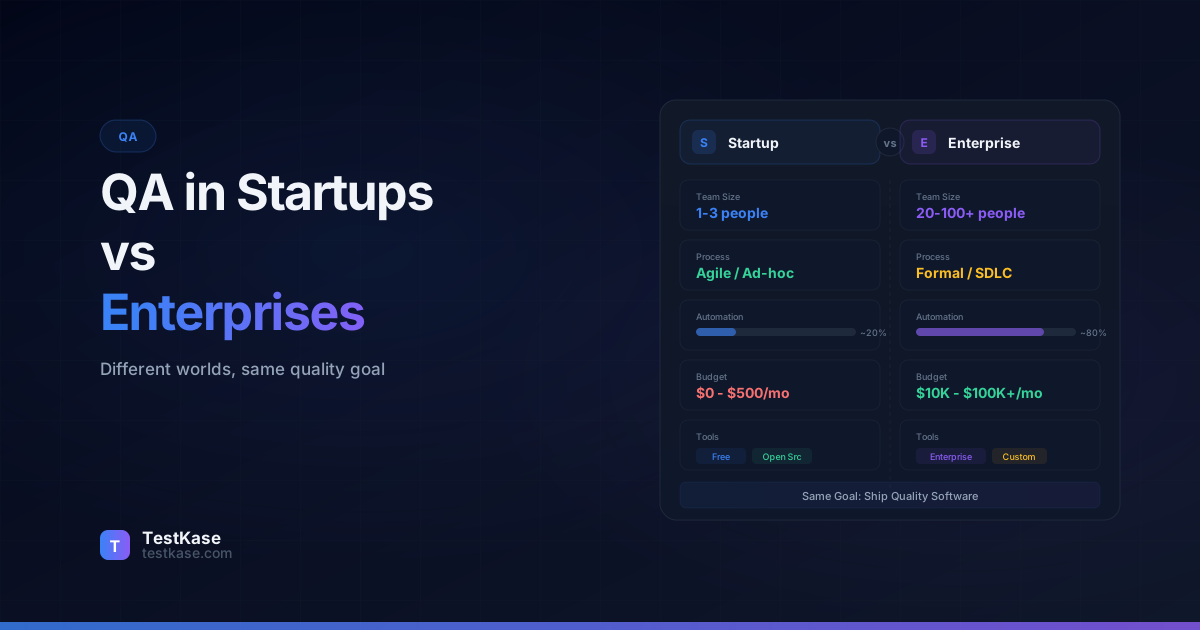
In a typical seed-to-Series-B startup, one QA engineer supports 8-15 developers, test coverage focuses on 20% of the product that drives 80% of revenue, and the testing "process" fits in a Notion page. This isn't negligence — it's resource-constrained pragmatism.
Wearing multiple hats is the defining characteristic of startup QA. Your sole QA engineer writes test cases, executes them, sets up automation, manages test data, triages bugs, sometimes writes bug fixes, and occasionally does customer support to understand real user pain points. There's no "that's not my job" in a startup QA team of one.
Consider a real scenario at a Series A fintech startup. Their lone QA engineer, hired as employee number 14, inherited a product with zero test coverage and a backlog of 200 unfiled bugs that customers had reported through support channels. In her first month, she:
- Cataloged the 50 most critical bugs from customer support tickets
- Built a smoke test suite of 12 Cypress tests covering signup, login, payment, and account settings
- Created a one-page bug reporting template in Notion
- Set up a Friday "bug bash" where all developers spent one hour doing exploratory testing
Within three months, production incidents dropped 40%. That's the startup QA multiplier effect — one person, applied strategically, transforms the entire quality posture.
Risk-based testing is instinctive, not formal. Enterprise teams have documented risk assessment matrices. Startup QA engineers do the same calculation intuitively: "The payment flow makes us money, so I'll test that thoroughly. The admin settings page? I'll glance at it." The logic is identical — the documentation isn't.
The instinctive approach works until it doesn't. The danger is implicit assumptions. When a startup QA engineer skips testing the admin settings, they're making an unconscious risk calculation that could be wrong. If the admin settings include a toggle that controls whether new signups require email verification, that "low-risk" page can cause a significant security incident. The difference between startup and enterprise risk assessment isn't the logic — it's the visibility of the reasoning.
Automation is scrappy and pragmatic. A startup QA engineer doesn't build a comprehensive Page Object Model framework with custom reporting. They write 15 Cypress tests for the critical path, hook them into GitHub Actions, and move on. If a test gets flaky, they might delete it rather than spend two days debugging it. The cost-benefit math is different when you have one person doing everything.
Here's what a typical startup automation suite looks like in practice:
// The entire critical-path test suite for a SaaS startup
// 12 tests, runs in 4 minutes, covers 80% of revenue-critical flows

describe('Critical Path - Signup & Onboarding', () => {
  it('completes signup with valid email', () => { /* ... */ });
  it('blocks signup with duplicate email', () => { /* ... */ });
});

describe('Critical Path - Core Workflow', () => {
  it('creates a new project', () => { /* ... */ });
  it('invites a team member', () => { /* ... */ });
  it('uploads a file under 10MB', () => { /* ... */ });
});

describe('Critical Path - Billing', () => {
  it('upgrades from free to paid plan', () => { /* ... */ });
  it('processes monthly payment', () => { /* ... */ });
  it('applies valid discount code', () => { /* ... */ });
  it('rejects expired discount code', () => { /* ... */ });
});

describe('Critical Path - Account Management', () => {
  it('resets password via email link', () => { /* ... */ });
  it('exports account data as CSV', () => { /* ... */ });
  it('deletes account and confirms data removal', () => { /* ... */ });
});
Twelve tests. Four minutes to run. No framework, no abstraction layers, no custom reporters. If this suite passes, the startup has confidence that the features keeping the lights on still work.
Test environments are whatever's available. Dedicated staging environments with production-mirrored data? That's a luxury. Startup QA often happens on a developer's local machine, a shared staging instance that breaks twice a week, or — honestly — production, with a test account and crossed fingers.
A 2025 survey by LinearB found that 34% of startups with fewer than 50 employees test directly in production. While this sounds alarming, it often reflects a calculated trade-off: the cost of maintaining a separate staging environment (infrastructure, data sync, configuration drift) exceeds the risk of careful production testing with feature flags and test accounts.
Enterprise QA: Process as a Shield
Enterprise QA exists in a fundamentally different context. The product serves thousands or millions of users. A production bug might violate regulatory requirements. Releases go through change advisory boards. The QA function isn't just about finding bugs — it's about providing auditable evidence that the software was tested according to defined standards.
Specialized roles replace the startup generalist. Test designers write test cases. Test executors run them. Automation engineers build frameworks. Performance testers run load tests. Security testers do penetration testing. A QA manager coordinates all of them. Each role has depth that a startup generalist can't match, but the coordination overhead is significant.
In a large enterprise, the QA organization chart can look like this:
- VP of Quality Engineering — Owns the quality strategy across all product lines
- QA Managers (3-5) — Each responsible for a product domain
- QA Leads (10-15) — Coordinate testing within a specific team or release train
- Test Designers (10-20) — Write test cases from requirements and acceptance criteria
- Test Executors (20-40) — Run manual test cases during test cycles
- SDETs (10-20) — Build and maintain automation frameworks
- Performance Engineers (3-5) — Manage load testing infrastructure and execution
- Security Testers (2-4) — Conduct penetration testing and vulnerability scanning
- Environment Engineers (3-5) — Manage staging, QA, and pre-production environments
That's potentially 80+ people in the QA organization alone. The specialization enables depth — an SDET who focuses exclusively on API test automation will build more sophisticated frameworks than a startup generalist who does everything. But the coordination cost is enormous. Meetings, handoff documents, dependency tracking, and cross-team alignment consume 30-40% of an enterprise QA team's time.
Process documentation is comprehensive. Enterprise QA teams maintain test strategies, test plans, requirements traceability matrices, defect classification schemas, and sign-off checklists. This documentation exists partly for quality purposes and partly for compliance — auditors need to see that testing was planned, executed, and reviewed.
For example, a healthcare software company subject to FDA 21 CFR Part 11 regulations must demonstrate that every software requirement has been verified through testing, that test evidence is complete and unaltered, and that electronic signatures on test approvals are validated. The test documentation isn't optional bureaucracy — it's a legal requirement.
Automation is industrial-grade. Enterprise automation frameworks handle hundreds of thousands of tests across multiple platforms, browsers, and device configurations. They integrate with CI/CD pipelines, report to dashboards, and run nightly regression suites that take hours to complete. The investment is massive — dedicated teams of 5-10 SDETs — but so is the coverage.
A typical enterprise automation architecture includes:
- Test framework layer: Custom framework built on Selenium/Playwright with Page Object Model, data-driven testing, and cross-browser support
- Test data layer: Automated data generation and cleanup using factory patterns or database seeding scripts
- Infrastructure layer: Selenium Grid or cloud-based execution (BrowserStack, Sauce Labs) running tests in parallel across 20+ browser/OS combinations
- Reporting layer: Custom dashboards aggregating results from nightly runs, showing pass rate trends, flaky test tracking, and coverage metrics
- Integration layer: Hooks into Jira for automatic defect creation, Slack for failure notifications, and test management tools for traceability
Test environments are managed infrastructure. Enterprise QA has dedicated environment teams that provision, configure, and maintain staging environments with production-like data (sanitized for privacy). Environment requests go through tickets. Deployments follow schedules. This eliminates the "who broke staging?" chaos but adds lead time to everything.
The Cost of Quality: Startup vs Enterprise by the Numbers
Understanding the economic differences helps contextualize why each environment makes the trade-offs it does.
Startup economics. A seed-stage startup with $2M in funding and 15 employees allocates roughly 2-5% of their total budget to QA — often just one salary plus a few hundred dollars in tool subscriptions. The cost of a production bug is measured in customer churn and reputation damage, but the cost of slow shipping is measured in runway: every week of delay is a week closer to running out of money.
Data from CB Insights shows that 42% of startups fail because they build products nobody wants. In this context, shipping fast and learning from the market is existentially more important than preventing every possible bug. A startup that ships a buggy feature and iterates based on feedback often outperforms one that ships a perfect feature three months too late.
Enterprise economics. An enterprise with $500M in annual revenue might spend 15-25% of its IT budget on quality engineering. The cost of a production bug is measured in SLA violations ($50K-$500K per incident), regulatory fines (up to 4% of annual revenue for GDPR violations), and customer contract penalties. The cost of a missed quarterly release is measured in competitive positioning, but a single major incident can cost more than an entire year's QA budget.
According to the Consortium for Information & Software Quality (CISQ), the cost of poor software quality in the US reached $2.08 trillion in 2020. For individual enterprises, Gartner estimates the average cost of IT downtime at $5,600 per minute. At that rate, a two-hour outage caused by an untested deployment costs $672,000 — far more than a QA team's annual salary.
What Startups Can Learn from Enterprises
Startups often dismiss enterprise QA practices as bureaucratic overhead. But some of that "bureaucracy" exists because enterprises learned painful lessons that startups haven't encountered yet.
Documentation Prevents Knowledge Loss
When your solo QA engineer quits — and eventually they will — what happens to all the testing knowledge in their head? Which features are fragile? What test data configurations reveal bugs? Where are the known issues that everyone has learned to work around?
Enterprise QA's insistence on documented test cases, known issue lists, and process documentation isn't bureaucracy — it's organizational resilience. Startups should document at least their critical path test cases, known product quirks, and environment setup procedures. Not a 200-page test plan — a living document that survives personnel changes.
A practical approach for startups is what I call the "bus factor document" — a single document that answers: "If our QA person were unavailable tomorrow, what would someone need to know to keep quality from falling off a cliff?" It covers:
- Critical path flows — The 10-15 user journeys that must work for the business to function
- Known fragile areas — Parts of the codebase that break easily and require extra attention
- Environment setup — How to configure test environments, including credentials and data
- Automation suite — Where tests live, how to run them, and what to do when they fail
- Historical quirks — Product behaviors that look like bugs but are intentional
This document takes one day to create and saves weeks of ramp-up time for a replacement hire.
Regression Testing Prevents Embarrassment
Startups often skip regression testing because "we only changed the payment module, so why would we test search?" Because shared database queries, API middleware, and global CSS exist, that's why. Enterprise regression suites exist because enterprises have been burned by cascade failures enough times to invest in prevention.
You don't need 5,000 regression tests. You need 50 tests that cover your critical flows, running automatically on every deploy. That's an enterprise practice adapted to startup scale — and it catches the bugs that make your CEO apologize on Twitter.
A concrete example: a B2B SaaS startup deployed a change to their user profile API that updated the serialization format for dates. The change passed all profile-related tests. But the search feature also consumed user profile data to display results, and the new date format broke the search result cards. Users saw "NaN/NaN/NaN" instead of dates for two days before anyone noticed. A 30-second search regression test would have caught it instantly.
The Startup Regression Minimum
Identify your product's 10 most critical user flows. Write one automated test for each. Run them on every deploy. This takes one week to set up and prevents the class of regression bugs that startups most commonly ship to production. If you add nothing else to your QA practice this quarter, add this.
Structured Bug Triage Saves Time
A Slack message saying "payment is broken" triggers a fire drill. A properly triaged bug report saying "discount codes over $999 fail with a 500 error on the /apply-discount endpoint, affecting approximately 3% of transactions, severity: high, workaround: apply discount manually via admin panel" lets the team prioritize calmly.
Enterprise triage processes — severity classification, impact assessment, workaround documentation — take minutes to apply and save hours of panic-driven debugging.
Here's a lightweight severity matrix that startups can adopt without overhead:
| Severity | Definition | Response Time | Example | |----------|-----------|--------------|---------| | Critical | Revenue-impacting, no workaround | Fix within hours | Payment processing fails for all users | | High | Major feature broken, workaround exists | Fix within 1 sprint | CSV export times out for accounts with 1000+ records | | Medium | Feature partially broken, low user impact | Prioritize in backlog | Date picker doesn't work on Safari mobile | | Low | Cosmetic or minor inconvenience | Address when convenient | Tooltip text has a typo |
This four-tier system takes 30 seconds to apply and transforms panic-driven firefighting into data-driven prioritization.
Metrics Provide Visibility
Enterprise QA teams track defect escape rate, test coverage percentages, cycle time, and pass/fail trends. Startups typically track nothing. The problem with tracking nothing is that you can't answer basic questions: "Is our product quality improving or declining?" "Are we catching more bugs before release or fewer?" "Which product areas are most fragile?"
You don't need a BI dashboard. A simple spreadsheet tracking three metrics is enough:
- Production incidents per week — Are things getting better or worse?
- Bugs caught in QA vs production — Is testing effective?
- Time to resolve critical bugs — Is the team responsive?
What Enterprises Can Learn from Startups
Enterprise QA teams should look at startup practices not as shortcuts but as efficiency patterns that challenge assumptions about what's truly necessary.
Speed Reveals What Matters
When you can only test 20% of the product, you learn very quickly which 20% matters most. Enterprise QA teams that test everything equally often spend significant effort on low-risk areas while under-testing high-risk ones. The startup practice of ruthless prioritization — test what makes money, test what's new, skip what's stable — applies at any scale.
Enterprise teams should regularly ask: "If we could only run 100 tests before this release, which 100 would we choose?" That exercise reveals which of your 10,000 test cases are actually driving quality decisions and which are maintenance overhead.
One enterprise QA director I spoke with described conducting this exercise with her team of 35 testers. They had 12,000 test cases in their regression suite. When asked to pick the 100 most important, the team identified them within two hours. When they analyzed the historical data, those 100 tests had caught 89% of the regression bugs found in the previous year. The other 11,900 tests had collectively caught the remaining 11%. They didn't delete the other tests, but they restructured their execution strategy to always run the critical 100 first and use the remaining tests selectively based on risk analysis of each release.
Pragmatic Automation Beats Comprehensive Automation
Enterprise automation teams sometimes spend months building a framework before writing a single test. By the time the framework is ready, the product has changed and some of the planned tests are already obsolete.
Startup QA's approach — write a test that works now, refactor later if needed, delete if it's not worth maintaining — produces faster feedback loops. Enterprise teams can adopt this mindset by maintaining a "fast lane" automation suite that covers the critical path with simple, maintainable tests alongside the comprehensive framework.
The fast lane concept works like this:
Comprehensive Framework (runs nightly, 4 hours)
├── 8,000 tests across all modules
├── Cross-browser matrix (Chrome, Firefox, Safari, Edge)
├── Full data-driven scenarios
└── Detailed reporting with screenshots

Fast Lane Suite (runs on every PR, 8 minutes)
├── 100 critical path tests
├── Chrome only
├── Hardcoded happy-path data
└── Pass/fail notification to Slack
The fast lane gives developers immediate feedback on every pull request. The comprehensive suite provides thorough coverage overnight. Both serve a purpose, but the fast lane is what prevents most regressions from reaching production.
Direct Communication Beats Process
In a startup, the QA engineer walks over to the developer and says "this is broken, here's what I see." The issue gets fixed in an hour. In an enterprise, the same bug goes through a defect tracking workflow, gets assigned to a sprint, waits for prioritization, and gets fixed in two weeks.
Not every bug needs a two-week workflow. Enterprise teams can create a "fast track" process for critical bugs — a dedicated Slack channel where QA can escalate directly to the responsible developer, bypassing the normal triage flow for genuinely urgent issues.
Some enterprises formalize this with a "war room" protocol: when a critical bug is found during testing, the QA engineer can invoke a war room that pulls the relevant developer and product manager into a focused resolution session within 30 minutes. The key constraint is that the protocol should only be invoked for genuine critical issues — overuse defeats the purpose.
Reduce Process Debt Regularly
Just as code accumulates technical debt, QA processes accumulate "process debt" — steps, documents, and approvals that were added for good reason but are no longer necessary. Enterprise QA teams should conduct quarterly process audits:
- Which approval steps actually catch issues vs. rubber-stamp everything?
- Which documentation artifacts do people actually read?
- Which test cases haven't found a bug in two years?
- Which meetings could be replaced by async updates?
Startups are forced to stay lean by resource constraints. Enterprises must actively choose leanness through regular pruning.
Don't Copy Blindly
The worst outcome is a startup implementing enterprise-grade process overhead or an enterprise adopting startup-style "just ship it" recklessness. Adapt practices to your context. Ask "what problem does this practice solve?" and only adopt it if you actually have that problem.
Right-Sizing QA for Your Stage
The right QA approach depends on where your company is, not where you wish it was. Here's a practical framework for matching QA practices to company stage:
Pre-product-market-fit (1-20 employees). The product is still finding its shape. Features get built and killed regularly. QA is everyone's side job. Focus: basic smoke tests before releases, developers writing unit tests, and one person doing ad-hoc exploratory testing. Tools: a spreadsheet and your existing issue tracker. Budget: $0-$500/month on QA-specific tools.
Post-PMF, scaling (20-100 employees). You've found your market and you're growing. Customer count is rising and so are the consequences of bugs. Focus: hire your first dedicated QA person, establish critical path test cases, add basic automation, define a bug reporting standard. Tools: a test management platform, basic automation framework. Budget: $500-$5,000/month.
Growth stage (100-500 employees). Multiple product lines, multiple teams, regulatory or compliance considerations appearing. Focus: QA team of 5-15, organized by product area, automation covering regression, formal test cycles, metrics tracking. Tools: integrated test management, CI/CD-connected automation, reporting dashboards. Budget: $10,000-$50,000/month.
Enterprise scale (500+ employees). Global teams, complex products, regulatory requirements, multiple release trains. Focus: specialized QA roles, comprehensive automation, dedicated test environments, traceability, audit-ready documentation. Tools: enterprise test management, performance testing, security testing, environment management. Budget: $100,000+/month.
The key is evolving incrementally. Every transition — from ad-hoc to structured, from structured to scaled — should happen in response to actual pain, not theoretical best practices.
A Hybrid Approach: Taking the Best from Both Worlds
The most effective QA organizations don't identify as "startup-style" or "enterprise-style" — they pick the right practices from each for their specific context. Here's a practical hybrid model:
From startups, adopt:
- Risk-based test prioritization (always know which 20% of tests matter most)
- Fast feedback loops (critical path tests run on every deployment)
- Direct communication channels for urgent issues
- Willingness to delete tests that aren't providing value
- Bias toward action over documentation
From enterprises, adopt:
- Documented critical path test cases (survive personnel changes)
- Structured severity classification (enable calm prioritization)
- Automated regression suites (prevent embarrassing cascade failures)
- Metrics tracking (answer "is quality improving?")
- Dedicated test environments for complex scenarios
From neither:
- Testing everything equally regardless of risk
- Skipping regression testing entirely
- Treating QA as a gate or bottleneck
- Measuring QA by raw bug counts
- Implementing processes without understanding why
Common Mistakes at Every Stage
Startups over-engineering too early. Building a comprehensive automation framework when your product hasn't found PMF yet is premature optimization. You'll rewrite everything when the product pivots. A startup that spent three months building a custom test framework before PMF watched that investment become worthless when they pivoted from a B2C marketplace to a B2B SaaS product.
Enterprises under-investing in change. Continuing to use heavyweight processes designed for annual releases when you've moved to monthly releases creates friction that slows the entire organization. One financial services company still required physical sign-off on test plans two years after moving to cloud deployment. The sign-off process added five business days to every release.
Both: ignoring the QA team's input on process. QA engineers know what works and what doesn't. They live inside the process every day. Imposing processes designed by managers who don't execute tests daily leads to processes that look good on paper and fail in practice.
Both: treating QA as a phase, not a practice. Quality isn't something that happens after development. It starts in requirements, continues through design and code review, and extends through testing to production monitoring. The best teams — startup or enterprise — embed quality thinking into every stage of the development lifecycle.
Both: neglecting production monitoring. Neither startups nor enterprises should consider their QA job done at deployment. Production monitoring — error rates, performance metrics, user behavior analytics — is the final safety net. A 2025 Datadog report found that organizations with integrated QA and observability practices resolve production incidents 60% faster than those with separate workflows.
How TestKase Scales with You
TestKase is designed to work at every stage — from a solo QA engineer at a startup to a 50-person enterprise QA organization. Start with simple test case management and manual test cycles. Add automation result integration when you build your first test framework. Scale to multiple projects, teams, and dashboards as your organization grows.
The platform doesn't force enterprise-grade process on startup teams or limit enterprise teams with startup-tier functionality. Folder structures, role-based access, Jira integration, and AI-powered test generation are available when you need them and out of the way when you don't.
Whether you're a founder hiring your first QA engineer or a QA director managing a global team, TestKase provides the test management foundation that fits your current stage — and grows with you to the next one.
Start Free — Scale When ReadyConclusion
Startup QA and enterprise QA look like different disciplines, but they share the same goal: ship software that works for users. Startups optimize for speed and pragmatism. Enterprises optimize for coverage and compliance. The best QA teams — at any scale — borrow from both worlds: enterprise-level discipline on critical paths, startup-level pragmatism on everything else.
The data supports this hybrid approach. Organizations that blend startup agility with enterprise discipline report 35-45% fewer production escapes than those that adopt either extreme, according to a 2025 Capgemini World Quality Report.
Assess your current stage honestly, adopt practices that solve problems you actually have, and evolve incrementally as your product and team grow. Quality isn't a destination — it's a practice that scales with you.
Stay up to date with TestKase
Get the latest articles on test management, QA best practices, and product updates delivered to your inbox.
SubscribeShare this article
Related Articles
Critical, Serious, Moderate, Minor: How to Triage Accessibility Issues by Severity
A practical triage policy template — SLAs per severity, ownership across design / engineering / content / QA, and how to share findings cross-team without forwarding PDFs.
Read more →Why Single-Page Accessibility Scans Miss Real Bugs (and What Multi-Page Audits Catch)
Single-URL accessibility scanners miss six entire categories of WCAG violations. Here's what falls through the gap, and how flow-aware audits catch the issues your users actually hit.
Read more →Accessibility Testing in CI/CD: Catching WCAG Issues Before They Ship
Three integration patterns, GitHub Actions / GitLab / CircleCI templates, and a 3-quarter rollout playbook to take an engineering team from zero accessibility in CI to block-on-fail.
Read more →