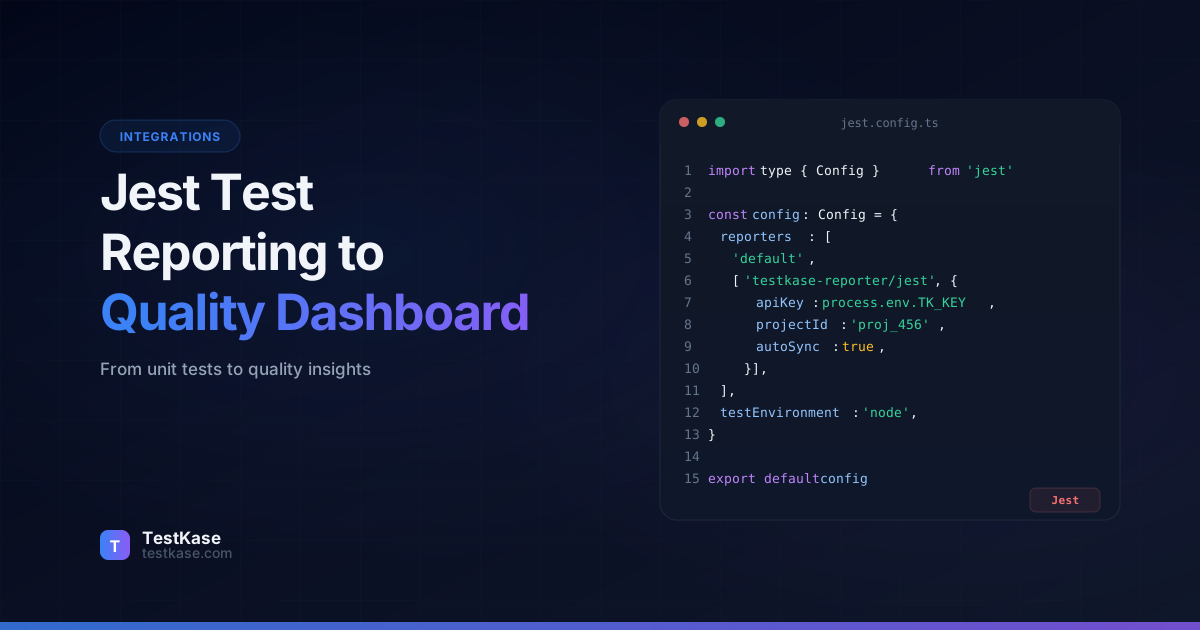
Jest Test Reporting: From Unit Tests to Quality Dashboard

Jest Test Reporting: From Unit Tests to Quality Dashboard
Your team runs thousands of Jest tests every day. Green checkmarks fly past in the terminal, a coverage percentage flashes on screen, and everyone moves on. But here is the problem — all that test data vanishes the moment the CI job finishes. Nobody tracks which tests flake out every Tuesday. Nobody notices that the payments module has been hovering at 42% coverage for six months. Nobody correlates a spike in test failures with last week's refactor.
A 2025 survey by SmartBear found that 61% of development teams run unit tests but fewer than 20% feed those results into any kind of quality dashboard. That means the vast majority of teams are sitting on a goldmine of quality signals and doing absolutely nothing with them. Jest produces rich, structured output — pass/fail status, durations, suite hierarchies, snapshot diffs, coverage maps — yet most teams treat it as a binary: did the build pass or not?
The waste is quantifiable. A typical mid-size project running 3,000 Jest tests in CI generates roughly 15,000 data points per run: pass/fail status, execution duration, and failure details for each test, plus module-level coverage percentages. Over a month of daily runs, that is 450,000 data points — enough to build a comprehensive picture of code quality trends, test reliability, and engineering velocity. Without a reporting pipeline, all of that data disappears into CI log archives that nobody reads.
This post walks you through turning Jest's raw output into actionable QA intelligence. You will learn how Jest's reporter system works, how to build custom reporters, how to pipe results into your test management platform, and how to construct a quality dashboard that actually changes how your team ships software.
How Jest's Reporter System Works
Jest ships with a modular reporter architecture. Every time you run jest, one or more reporters receive lifecycle hooks — onRunStart, onTestResult, onRunComplete — and decide what to do with the data. The default reporter prints results to stdout, but you can swap it out or stack multiple reporters together.
Jest Reporter Lifecycle
Jest reporters receive structured data at three key moments: when the run starts (total test suites), after each suite completes (individual results, durations, failures), and when the entire run finishes (aggregate stats, coverage summaries). This makes them perfect for feeding data into external systems.
Out of the box, Jest includes several built-in reporters:
- default — The colorful terminal output you see every day. Shows pass/fail, durations, and failure details.
- verbose — Prints every individual test name, grouped by
describeblock. Useful for debugging but noisy in CI. - jest-junit — Generates JUnit XML files, the lingua franca of CI systems. Jenkins, GitLab CI, and CircleCI all consume this format natively.
- json — Outputs raw JSON with every detail Jest knows. The foundation for custom tooling.
You configure reporters in jest.config.js:
module.exports = {
  reporters: [
    'default',
    ['jest-junit', { outputDirectory: './reports', outputName: 'junit.xml' }],
    './custom-reporter.js',
  ],
};
The key insight is that you can run multiple reporters simultaneously. Keep default for developer experience, add jest-junit for CI, and layer on a custom reporter that pushes results to your test management tool — all from the same test run.
Understanding the Reporter Data Model
Before building custom reporters, it helps to understand the data structures Jest passes to each hook. The onTestResult hook receives a TestResult object with this shape:
interface TestResult {
  testFilePath: string;           // Absolute path to the test file
  numPassingTests: number;
  numFailingTests: number;
  numPendingTests: number;
  perfStats: {
    start: number;                // Unix timestamp
    end: number;
    runtime: number;              // Duration in ms
  };
  testResults: Array<{
    fullName: string;             // "describe > it" concatenated
    status: 'passed' | 'failed' | 'pending' | 'skipped';
    duration: number | null;      // ms
    failureMessages: string[];    // Stack traces
    ancestorTitles: string[];     // Nested describe blocks
  }>;
  snapshot: {
    added: number;
    matched: number;
    unmatched: number;
    updated: number;
  };
}
And the onRunComplete hook receives an AggregatedResult:
interface AggregatedResult {
  numTotalTestSuites: number;
  numPassedTestSuites: number;
  numFailedTestSuites: number;
  numTotalTests: number;
  numPassedTests: number;
  numFailedTests: number;
  numPendingTests: number;
  startTime: number;
  success: boolean;
  coverageMap?: CoverageMap;      // Istanbul coverage data
}
Understanding these structures means you can extract exactly the data your dashboard needs — no more, no less.
Building a Custom Reporter for Test Management
The real power unlocks when you write a custom reporter that maps Jest results to your test management system. Here is the anatomy of a reporter that pushes results to an API:
class TestManagementReporter {
  constructor(globalConfig, options) {
    this.apiUrl = options.apiUrl;
    this.projectId = options.projectId;
    this.results = [];
  }

  onTestResult(test, testResult) {
    for (const result of testResult.testResults) {
      this.results.push({
        suiteName: testResult.testFilePath,
        testName: result.fullName,
        status: result.status, // 'passed', 'failed', 'pending'
        duration: result.duration,
        failureMessages: result.failureMessages,
      });
    }
  }

  async onRunComplete(contexts, aggregatedResult) {
    await fetch(`${this.apiUrl}/runs`, {
      method: 'POST',
      headers: { 'Content-Type': 'application/json' },
      body: JSON.stringify({
        projectId: this.projectId,
        timestamp: new Date().toISOString(),
        totals: {
          passed: aggregatedResult.numPassedTests,
          failed: aggregatedResult.numFailedTests,
          skipped: aggregatedResult.numPendingTests,
        },
        results: this.results,
      }),
    });
  }
}

module.exports = TestManagementReporter;
This reporter collects every test result during the run, then fires a single API call with the complete payload when the run finishes. The key decisions you will face:
- Granularity — Do you push every individual
it()block, or aggregate at thedescribelevel? For most teams, pushing individual tests gives you the most useful trend data. - Mapping — How do you connect a Jest test name like
"PaymentService > processRefund > should handle partial refunds"to a test case in your management tool? Naming conventions or test IDs embedded in the test name work well. - Failure detail — Jest's
failureMessagesarray contains stack traces and assertion diffs. Pushing these into your test management tool means QA engineers can triage failures without digging through CI logs.
Use Test IDs for Mapping
Add a test case ID from your test management tool directly into Jest test names: it('[TC-1042] should handle partial refunds', ...). Your custom reporter can parse this ID and automatically link results to the right test case. This eliminates manual mapping entirely.
Adding Retry and Error Handling to Your Reporter
A production-grade reporter needs to handle failures gracefully. If your dashboard API is down when tests finish, you should not lose the data. Here is an enhanced version with retry logic and local fallback:
class ResilientReporter {
  constructor(globalConfig, options) {
    this.apiUrl = options.apiUrl;
    this.projectId = options.projectId;
    this.fallbackDir = options.fallbackDir || './test-results';
    this.maxRetries = options.maxRetries || 3;
    this.results = [];
  }

  onTestResult(test, testResult) {
    for (const result of testResult.testResults) {
      this.results.push({
        suiteName: testResult.testFilePath.replace(process.cwd(), ''),
        testName: result.fullName,
        testId: this.extractTestId(result.fullName),
        status: result.status,
        duration: result.duration,
        failureMessages: result.failureMessages,
        ancestorTitles: result.ancestorTitles,
      });
    }
  }

  extractTestId(testName) {
    const match = testName.match(/\[TC-(\d+)\]/);
    return match ? `TC-${match[1]}` : null;
  }

  async onRunComplete(contexts, aggregatedResult) {
    const payload = {
      projectId: this.projectId,
      timestamp: new Date().toISOString(),
      gitSha: process.env.GITHUB_SHA || process.env.CI_COMMIT_SHA || 'local',
      branch: process.env.GITHUB_REF_NAME || process.env.CI_BRANCH || 'local',
      totals: {
        passed: aggregatedResult.numPassedTests,
        failed: aggregatedResult.numFailedTests,
        skipped: aggregatedResult.numPendingTests,
        duration: Date.now() - aggregatedResult.startTime,
      },
      results: this.results,
    };

    let pushed = false;
    for (let attempt = 1; attempt <= this.maxRetries; attempt++) {
      try {
        const response = await fetch(`${this.apiUrl}/runs`, {
          method: 'POST',
          headers: { 'Content-Type': 'application/json' },
          body: JSON.stringify(payload),
        });
        if (response.ok) {
          pushed = true;
          break;
        }
      } catch (err) {
        console.warn(`Reporter push attempt ${attempt} failed: ${err.message}`);
      }
    }

    if (!pushed) {
      // Write to local file as fallback
      const fs = require('fs');
      const path = require('path');
      fs.mkdirSync(this.fallbackDir, { recursive: true });
      const filename = `results-${Date.now()}.json`;
      fs.writeFileSync(
        path.join(this.fallbackDir, filename),
        JSON.stringify(payload, null, 2)
      );
      console.warn(`Reporter: API push failed. Results saved to ${filename}`);
    }
  }
}

module.exports = ResilientReporter;
This pattern ensures you never lose test data — if the API is unreachable, results are written to a local file that can be uploaded later via a recovery script.
Mapping Jest Suites to Test Cases
The mapping between Jest's test hierarchy and your test management structure is where most teams stumble. Jest organizes tests as files containing describe blocks containing it blocks. Test management tools organize tests as folders containing test suites containing test cases. The structures look similar but do not align automatically.
For snapshot tests specifically, the mapping gets tricky. A snapshot test does not have traditional pass/fail criteria — it compares against a stored baseline. When a snapshot changes, it might be a legitimate UI update or a regression. Your reporter should flag snapshot failures differently from assertion failures so QA engineers can distinguish "needs review" from "definitely broken."
Here is a practical approach: create a naming convention where your Jest test file structure mirrors your test management folder structure. If your test management tool has Payments > Refunds > Partial Refunds, name your Jest file payments/refunds/partialRefunds.test.ts and your reporter can auto-map by parsing the path.
Handling Parameterized Tests with test.each
Jest's test.each allows you to run the same test logic with different data. This creates a mapping challenge — do you create one test case in your management tool or multiple?
describe('Tax Calculator', () => {
  test.each([
    { state: 'CA', rate: 0.0725, expected: 72.50 },
    { state: 'TX', rate: 0.0625, expected: 62.50 },
    { state: 'OR', rate: 0.0, expected: 0.0 },
    { state: 'NY', rate: 0.08, expected: 80.00 },
  ])('calculates $rate tax for $state', ({ state, rate, expected }) => {
    expect(calculateTax(1000, state)).toBe(expected);
  });
});
The recommended approach is to create one test case in your management tool (TC-501: Tax calculation by state) and treat each parameterized run as a separate execution result. Your reporter can tag each result with the parameter values:
// In your custom reporter
onTestResult(test, testResult) {
  for (const result of testResult.testResults) {
    this.results.push({
      testName: result.fullName,
      testId: this.extractTestId(result.ancestorTitles[0]),
      parameterValues: this.extractParameters(result.fullName),
      status: result.status,
      duration: result.duration,
    });
  }
}
This way, your dashboard can show that TC-501 passed for CA, TX, and OR but failed for NY — far more useful than a single pass/fail.
CI/CD Integration: Making It Automatic
A reporter that only works when someone remembers to add a flag is a reporter that will not get used. The goal is zero-friction — every CI run should push results automatically.
For GitHub Actions, the setup looks like this:
- name: Run Jest with reporting
  run: npx jest --ci --reporters=default --reporters=./reporters/dashboard-reporter.js
  env:
    TESTKASE_API_KEY: ${{ secrets.TESTKASE_API_KEY }}
    TESTKASE_PROJECT_ID: ${{ vars.PROJECT_ID }}
The --ci flag is critical. It changes Jest's behavior in ways that matter for reporting: it disables interactive mode, forces all tests to run (no watch mode), and makes Jest fail with a non-zero exit code on snapshot mismatches. Without --ci, your CI pipeline might report green even when snapshots are out of date.
Don't Forget the Exit Code
Jest exits with code 1 when tests fail, which normally stops your CI pipeline. If your custom reporter's onRunComplete makes an async API call, make sure it completes before Jest exits. Use async/await in your reporter — Jest supports async lifecycle methods since version 27.
For teams running Jest in parallel with --shard, you need an extra step. Each shard produces partial results, so your reporter — or a downstream aggregation step — needs to merge them. One pattern: have each shard write a JSON fragment, then run a post-test step that combines them and pushes the merged result.
Here is a complete GitHub Actions workflow that handles sharding, result aggregation, and dashboard pushing:
name: Test & Report
on: [push, pull_request]

jobs:
  test:
    runs-on: ubuntu-latest
    strategy:
      matrix:
        shard: [1, 2, 3, 4]
    steps:
      - uses: actions/checkout@v4
      - uses: actions/setup-node@v4
        with:
          node-version: 20

      - run: npm ci

      - name: Run tests (shard ${{ matrix.shard }}/4)
        run: |
          npx jest --ci --shard=${{ matrix.shard }}/4 \
            --reporters=default \
            --reporters=./reporters/json-fragment-reporter.js
        env:
          SHARD_INDEX: ${{ matrix.shard }}

      - name: Upload shard results
        uses: actions/upload-artifact@v4
        with:
          name: test-results-shard-${{ matrix.shard }}
          path: ./test-results/shard-${{ matrix.shard }}.json

  report:
    needs: test
    runs-on: ubuntu-latest
    steps:
      - uses: actions/checkout@v4

      - name: Download all shard results
        uses: actions/download-artifact@v4
        with:
          path: ./test-results
          pattern: test-results-shard-*
          merge-multiple: true

      - name: Merge and push results
        run: node ./scripts/merge-and-push-results.js
        env:
          TESTKASE_API_KEY: ${{ secrets.TESTKASE_API_KEY }}
GitLab CI and Jenkins Configuration
For GitLab CI, the approach is similar but uses artifacts and stages:
# .gitlab-ci.yml
test:
  stage: test
  script:
    - npm ci
    - npx jest --ci --reporters=default --reporters=jest-junit
  artifacts:
    when: always
    reports:
      junit: reports/junit.xml
    paths:
      - reports/
For Jenkins, use the JUnit XML reporter and the Jenkins JUnit plugin. The plugin automatically parses XML results and displays them in the Jenkins UI with trend charts — no custom reporter needed for basic visibility:
// Jenkinsfile
pipeline {
  agent any
  stages {
    stage('Test') {
      steps {
        sh 'npx jest --ci --reporters=default --reporters=jest-junit'
      }
      post {
        always {
          junit 'reports/junit.xml'
        }
      }
    }
  }
}
Aggregating Coverage with Test Results
Test pass/fail data alone tells you whether things work. Coverage data tells you whether you are testing the right things. Combining them on a single dashboard reveals insights neither metric provides alone.
Jest generates coverage in multiple formats via Istanbul: lcov, json-summary, text, clover. The json-summary format is the easiest to parse programmatically:
{
  "total": {
    "lines": { "total": 4200, "covered": 3150, "pct": 75 },
    "branches": { "total": 980, "covered": 620, "pct": 63.27 },
    "functions": { "total": 410, "covered": 350, "pct": 85.37 }
  }
}
The most powerful dashboard view combines coverage trends with test results over time. Imagine seeing that your payments module's line coverage dropped from 80% to 65% over the past month — and simultaneously, test failures in that module increased by 40%. That correlation screams "technical debt accumulating" louder than either metric alone.
Per-Module Coverage Tracking
Total coverage percentages hide important details. A project at 80% overall coverage might have 95% coverage in the utils module and 35% in payments. The overall number looks acceptable; the module-level breakdown reveals a serious risk.
Configure Jest to output per-file coverage and parse it in your reporter:
// jest.config.js
module.exports = {
  collectCoverage: true,
  coverageReporters: ['json-summary', 'json', 'text'],
  collectCoverageFrom: [
    'src/**/*.{js,ts}',
    '!src/**/*.d.ts',
    '!src/**/index.ts',
  ],
};
Then in your custom reporter, extract module-level data from the coverage map:
async onRunComplete(contexts, aggregatedResult) {
  const coverageMap = aggregatedResult.coverageMap;
  if (!coverageMap) return;

  const moduleStats = {};

  for (const filePath of coverageMap.files()) {
    const fileCoverage = coverageMap.fileCoverageFor(filePath);
    const summary = fileCoverage.toSummary();

    // Group by top-level directory under src/
    const module = filePath.split('/src/')[1]?.split('/')[0] || 'root';

    if (!moduleStats[module]) {
      moduleStats[module] = { lines: 0, coveredLines: 0, files: 0 };
    }
    moduleStats[module].lines += summary.lines.total;
    moduleStats[module].coveredLines += summary.lines.covered;
    moduleStats[module].files += 1;
  }

  // Push module-level coverage alongside test results
}
To make this work, your custom reporter should push coverage data alongside test results. Either extend the onRunComplete payload to include coverage summaries, or have a separate coverage reporter that pushes to the same dashboard API.
Building the Quality Dashboard
With data flowing from Jest into your reporting platform, the next step is building dashboard views that surface actionable insights. Here are the five views every team should have:
1. Daily Run Summary — A single screen showing today's test runs: total tests, pass rate, failed tests with failure messages, and comparison to yesterday. This is the view your team checks every morning.
2. Trend Charts — Pass rate, coverage, and test duration plotted over 30/60/90 days. Trend lines reveal gradual degradation that daily summaries miss.
3. Flake Tracker — A table of tests sorted by flake rate over the past 30 days, showing how many times each test ran and how many times it failed. The top 10 entries are your fix priority list.
4. Module Health Map — A heat map or tree map showing each module's coverage percentage and test pass rate. Red modules need attention; green modules are healthy.
5. Slowest Tests — The 20 slowest tests by average duration. Slow tests often indicate missing mocks (hitting real databases), excessive setup, or inefficient assertions. Fixing these improves developer experience and CI throughput.
Common Mistakes with Jest Reporting
Treating all failures equally. A flaky test that fails once every 20 runs is a fundamentally different problem from a test that broke because of a real regression. Your dashboard should distinguish between these — track flake rates over time and filter them from regression failure counts.
Ignoring test duration data. A test suite that used to run in 3 seconds and now takes 45 seconds is telling you something. Maybe a mock is not mocking correctly and you are hitting a real database. Maybe a new dependency is slow to initialize. Duration trends catch performance problems that pass/fail status misses entirely.
Overloading the reporter with logic. Your custom reporter should collect data and push it. Do not put business logic in the reporter — no "if this test fails, page the on-call engineer" decisions. Keep the reporter thin and handle logic in the dashboard or a downstream service.
Not versioning reporter configuration. When your reporter configuration lives in a CI environment variable that one person set up eighteen months ago, you are one infrastructure change away from losing all your quality data. Check reporter configs into version control alongside your Jest config.
Skipping local reporting. Developers should be able to see dashboard-relevant data locally, not just in CI. Consider a "dry run" mode for your custom reporter that outputs what it would push without actually calling the API:
// In your reporter constructor
this.dryRun = process.env.REPORTER_DRY_RUN === 'true';

// In onRunComplete
if (this.dryRun) {
  console.log('=== DRY RUN: Would push the following data ===');
  console.log(JSON.stringify(payload, null, 2));
  return;
}
Not testing the reporter itself. Your custom reporter is production code — it should have its own tests. Mock the fetch calls and verify that the reporter correctly transforms Jest results into your expected payload format.
How TestKase Streamlines Jest Reporting
TestKase is built to ingest automated test results — including Jest — and turn them into a unified quality dashboard alongside your manual test cases and test cycles.
With the TestKase reporter integration, you configure your Jest project once: add the reporter, set your API key, and map your test suites. From that point forward, every CI run pushes results into TestKase automatically. Your Jest tests appear alongside your manual test cases in a single view, with full history, trend charts, and flake detection.
The dashboard surfaces exactly the metrics that matter: pass rate trends, coverage changes, slowest tests, most frequently failing tests, and — critically — how your automated Jest results correlate with manual testing outcomes. When a Jest test for the checkout flow starts failing, you can instantly see whether the corresponding manual test cases have also been affected.
TestKase's folder-based organization mirrors natural project structure. Map your Jest test directories to TestKase folders, and navigation between your codebase and your test management tool becomes intuitive. Test cycles can include both automated Jest results and manual test executions, giving stakeholders a unified view of quality across all testing methods.
See TestKase Reporting PlansConclusion
Jest produces rich, structured test data on every run. The difference between teams that ship confidently and teams that constantly fight regressions often comes down to whether they actually use that data. Set up a custom reporter, pipe results into your test management tool, combine pass/fail with coverage trends, and build a dashboard that surfaces real signals — not just green checkmarks.
Start with the basics: jest-junit for CI visibility, then add a custom reporter that pushes to your quality platform. Within a few sprints, you will wonder how you ever made decisions without the trend data. The investment is small — a few hours to build the reporter, a few more to configure CI — but the payoff compounds with every run: better visibility, faster triage, and a shared understanding of quality that transcends "the build is green."
Stay up to date with TestKase
Get the latest articles on test management, QA best practices, and product updates delivered to your inbox.
SubscribeShare this article
Related Articles
Accessibility Testing in CI/CD: Catching WCAG Issues Before They Ship
Three integration patterns, GitHub Actions / GitLab / CircleCI templates, and a 3-quarter rollout playbook to take an engineering team from zero accessibility in CI to block-on-fail.
Read more →Auditing Pages Behind a Login: A Practical Guide to Authenticated Accessibility Scanning
Most accessibility scanners stop at your login page. Here's how to audit the 70% of your app that lives behind authentication — cookie, login form, and header methods compared.
Read more →We Gave Our Test Management Tool an AI Brain. Here's What Happened.
How we built an AI agent that manages test cases, cycles, and reports through conversation — and what we learned about what works and what doesn't.
Read more →