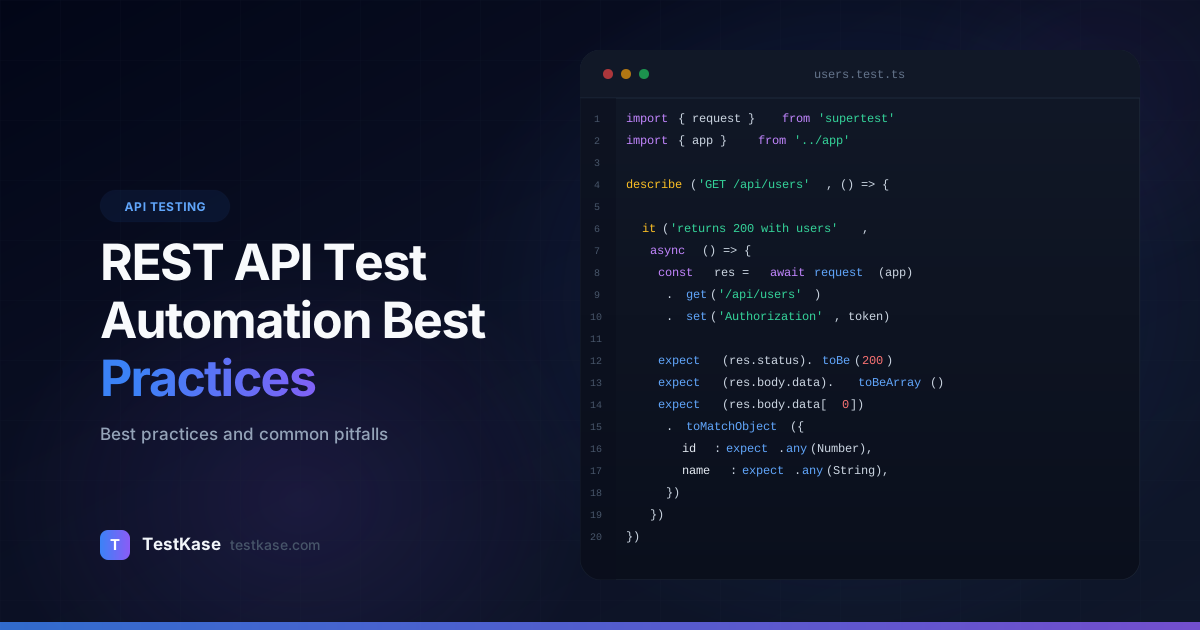
REST API Test Automation: Best Practices and Common Pitfalls

REST API Test Automation: Best Practices and Common Pitfalls
A team at a mid-size fintech company automated 400 API tests in three months. Six months later, they disabled half of them. The tests were slow, flaky, tightly coupled to test data that kept changing, and nobody could tell whether a failure meant a real bug or a stale token. Sound familiar?
API test automation has a deceptively low barrier to entry. Send a request, check the response, done. But building a suite that remains reliable, fast, and maintainable at scale — that's where most teams struggle. According to SmartBear's State of Software Quality report, 61% of teams say maintaining automated tests is their biggest challenge, with API tests being among the worst offenders.
The difference between a throwaway script and a production-grade API test suite comes down to design decisions made early. Authentication handling, data isolation, assertion strategy, environment configuration — these unglamorous details determine whether your tests will still be useful a year from now.
This guide covers the practices that separate teams who succeed with API test automation from those who end up disabling half their suite six months in.
The API Test Pyramid
Before writing a single test, you need a strategy for what to test at the API layer. Not every scenario deserves an automated API test.
Where API tests fit
API tests sit in the middle of the test pyramid — above unit tests (fast, isolated, thousands of them) and below UI tests (slow, brittle, dozens of them). A well-designed API test suite typically covers 200–500 scenarios for a medium-sized application, running in 5–15 minutes.
Your API test layer should cover:
- Business logic validation — Does the API enforce the rules? Can you create an order with a negative quantity?
- Input validation — Does it reject malformed payloads, missing required fields, and invalid data types?
- Authentication and authorization — Can an unauthenticated user access protected endpoints? Can a regular user access admin endpoints?
- Error handling — Are error responses consistent, informative, and correctly structured?
- Integration points — Does the API correctly interact with databases, caches, and downstream services?
What to leave out of API tests:
- UI-specific behavior — Button clicks, page navigation, rendering. That's for UI tests.
- Internal implementation details — Don't test which database query runs. Test the output.
- Third-party API behavior — Mock external dependencies. You're testing your API, not Stripe's.
Quantifying Your API Test Coverage
A useful exercise before writing tests is mapping your API surface. For each endpoint, list the HTTP methods, the expected success and error responses, and the business rules it enforces. This inventory becomes your test plan.
Here's a practical breakdown for a typical user management API:
| Endpoint | Methods | Happy Paths | Error Cases | Auth Scenarios | Total | |---|---|---|---|---|---| | /users | GET, POST | 2 | 5 | 3 | 10 | | /users/:id | GET, PUT, DELETE | 3 | 6 | 4 | 13 | | /users/:id/roles | GET, PUT | 2 | 4 | 5 | 11 | | /auth/login | POST | 1 | 4 | 2 | 7 | | /auth/refresh | POST | 1 | 3 | 1 | 5 |
A single API module with five endpoint groups already generates 46 test scenarios. For a medium-sized application with 15–20 endpoint groups, you're looking at 150–300 scenarios — and that's before adding performance or concurrency tests.
Prioritizing What to Automate First
Not all 300 scenarios deserve equal priority. Focus your initial automation effort on:
- Revenue-critical paths — Endpoints that process payments, create orders, or handle subscriptions. A bug here costs real money.
- Authentication and authorization — Security regressions are among the most damaging bugs. Automated auth tests catch privilege escalation and access control issues before they reach production.
- High-traffic endpoints — Endpoints called thousands of times per day have the highest blast radius for regressions.
- Recently changed endpoints — New or recently modified endpoints are most likely to have bugs. Prioritize testing them first.
Leave low-traffic administrative endpoints and rarely changing reference data endpoints for later rounds of automation.
Designing API Test Cases
Well-structured API test cases follow a pattern: one test, one scenario, one clear assertion focus. Avoid the temptation to chain 10 assertions into a single test — when it fails, you won't know which part broke.
Happy Path Tests
Start with the expected behavior. For a POST /users endpoint:
describe('POST /users', () => {
  it('creates a user with valid data', async () => {
    const response = await api.post('/users', {
      name: 'Jane Doe',
      email: `jane-${Date.now()}@example.com`,
      role: 'member',
    });

    expect(response.status).toBe(201);
    expect(response.data).toMatchObject({
      id: expect.any(Number),
      name: 'Jane Doe',
      role: 'member',
      createdAt: expect.any(String),
    });
  });
});
Notice the dynamic email — using Date.now() avoids collisions when tests run in parallel. We'll cover data management in detail shortly.
Error and Edge Case Tests
For every happy path, write 3–5 negative tests. These catch far more real bugs than happy path tests do.
it('rejects user creation without required email', async () => {
  const response = await api.post('/users', { name: 'Jane Doe' });
  expect(response.status).toBe(400);
  expect(response.data.error).toContain('email');
});

it('rejects duplicate email addresses', async () => {
  const email = `dup-${Date.now()}@example.com`;
  await api.post('/users', { name: 'First', email, role: 'member' });
  const response = await api.post('/users', { name: 'Second', email, role: 'member' });
  expect(response.status).toBe(409);
});

it('handles extremely long name input', async () => {
  const response = await api.post('/users', {
    name: 'A'.repeat(10000),
    email: `long-${Date.now()}@example.com`,
    role: 'member',
  });
  expect(response.status).toBe(400);
});
The 80/20 rule for API tests
Roughly 80% of API bugs are found by testing invalid inputs, missing fields, wrong data types, and unauthorized access. Spend more time on negative and boundary tests than on happy paths — that's where the real value is.
Boundary Value Tests
Boundary testing is especially valuable for APIs with numeric inputs, string length limits, and pagination:
describe('Pagination boundaries', () => {
  it('returns first page with default limit', async () => {
    const response = await api.get('/users?page=1');
    expect(response.status).toBe(200);
    expect(response.data.items.length).toBeLessThanOrEqual(20);
    expect(response.data.meta.page).toBe(1);
  });

  it('rejects page=0', async () => {
    const response = await api.get('/users?page=0');
    expect(response.status).toBe(400);
  });

  it('rejects negative page numbers', async () => {
    const response = await api.get('/users?page=-1');
    expect(response.status).toBe(400);
  });

  it('returns empty array for page beyond data range', async () => {
    const response = await api.get('/users?page=99999');
    expect(response.status).toBe(200);
    expect(response.data.items).toEqual([]);
  });

  it('respects maximum page size limit', async () => {
    const response = await api.get('/users?limit=1000');
    expect(response.data.items.length).toBeLessThanOrEqual(100); // server-enforced max
  });
});
Content-Type and Header Validation Tests
An often-overlooked category is testing that the API handles different content types and header combinations correctly:
describe('Content-Type handling', () => {
  it('accepts application/json', async () => {
    const response = await api.post('/users', userData, {
      headers: { 'Content-Type': 'application/json' },
    });
    expect(response.status).toBe(201);
  });

  it('rejects unsupported content types', async () => {
    const response = await api.post('/users', 'name=Jane', {
      headers: { 'Content-Type': 'application/x-www-form-urlencoded' },
    });
    expect(response.status).toBe(415); // Unsupported Media Type
  });

  it('returns correct content-type in response', async () => {
    const response = await api.get('/users');
    expect(response.headers['content-type']).toContain('application/json');
  });

  it('handles Accept header for version negotiation', async () => {
    const response = await api.get('/users', {
      headers: { 'Accept': 'application/vnd.api.v2+json' },
    });
    expect(response.status).toBe(200);
    expect(response.data.apiVersion).toBe('v2');
  });
});
Schema Validation
Beyond checking individual fields, validate the entire response schema. This catches unexpected field additions, removals, or type changes — especially useful when multiple teams work on the same API.
const Ajv = require('ajv');
const ajv = new Ajv();

const userSchema = {
  type: 'object',
  required: ['id', 'name', 'email', 'role', 'createdAt'],
  properties: {
    id: { type: 'integer' },
    name: { type: 'string', maxLength: 255 },
    email: { type: 'string', format: 'email' },
    role: { type: 'string', enum: ['admin', 'member', 'viewer'] },
    createdAt: { type: 'string', format: 'date-time' },
  },
  additionalProperties: false,
};

it('response matches the user schema', async () => {
  const response = await api.get('/users/1');
  const valid = ajv.validate(userSchema, response.data);
  expect(valid).toBe(true);
});
Schema validation acts as a safety net. Even if your individual assertions pass, a schema mismatch tells you the API contract has changed.
For larger APIs, consider generating schemas from your OpenAPI (Swagger) specification automatically. This ensures your tests always validate against the documented API contract:
const SwaggerParser = require('@apidevtools/swagger-parser');

let schemas;
beforeAll(async () => {
  const api = await SwaggerParser.validate('./openapi.yaml');
  schemas = api.components.schemas;
});

it('GET /users/:id matches OpenAPI schema', async () => {
  const response = await api.get('/users/1');
  const valid = ajv.validate(schemas.User, response.data);
  expect(valid).toBe(true);
});
Contract Testing with Consumer-Driven Contracts
For microservice architectures, schema validation alone is not enough. Consumer-driven contract testing ensures that API changes don't break downstream consumers:
// Consumer side — defines expectations
const { Pact } = require('@pact-foundation/pact');

const provider = new Pact({
  consumer: 'OrderService',
  provider: 'UserService',
  port: 1234,
});

describe('User API contract', () => {
  beforeAll(() => provider.setup());
  afterAll(() => provider.finalize());

  it('returns user details for a valid ID', async () => {
    await provider.addInteraction({
      state: 'user 42 exists',
      uponReceiving: 'a request for user 42',
      withRequest: {
        method: 'GET',
        path: '/users/42',
        headers: { Accept: 'application/json' },
      },
      willRespondWith: {
        status: 200,
        headers: { 'Content-Type': 'application/json' },
        body: {
          id: 42,
          name: Matchers.string('Jane Doe'),
          email: Matchers.email(),
          role: Matchers.term({ generate: 'member', matcher: 'admin|member|viewer' }),
        },
      },
    });

    const response = await axios.get('http://localhost:1234/users/42');
    expect(response.status).toBe(200);
    expect(response.data.id).toBe(42);
  });
});
The generated contract (a Pact file) is shared with the provider team, who runs it against their actual API to verify compatibility. This catches breaking changes before they reach integration testing.
Authentication and Token Management
Hardcoded tokens are the number one cause of flaky API tests. Tokens expire, get revoked, or differ between environments. Build authentication into your test infrastructure properly.
class ApiClient {
  constructor(baseURL) {
    this.client = axios.create({ baseURL });
    this.token = null;
    this.tokenExpiry = null;
  }

  async authenticate(username, password) {
    const response = await this.client.post('/auth/login', {
      username,
      password,
    });
    this.token = response.data.accessToken;
    this.tokenExpiry = Date.now() + (response.data.expiresIn * 1000);
    this.client.defaults.headers.common['Authorization'] =
      `Bearer ${this.token}`;
  }

  async ensureAuthenticated() {
    if (!this.token || Date.now() > this.tokenExpiry - 60000) {
      await this.authenticate(
        process.env.TEST_USER,
        process.env.TEST_PASSWORD
      );
    }
  }

  async get(path, config) {
    await this.ensureAuthenticated();
    return this.client.get(path, config);
  }

  async post(path, data, config) {
    await this.ensureAuthenticated();
    return this.client.post(path, data, config);
  }

  async put(path, data, config) {
    await this.ensureAuthenticated();
    return this.client.put(path, data, config);
  }

  async delete(path, config) {
    await this.ensureAuthenticated();
    return this.client.delete(path, config);
  }
}

// In test setup
let api;
beforeAll(async () => {
  api = new ApiClient(process.env.API_BASE_URL);
  await api.authenticate(
    process.env.TEST_USER,
    process.env.TEST_PASSWORD
  );
});
Key principles:
- Authenticate once per test suite, not per test — saves time and reduces load on the auth server
- Use environment variables for credentials — never commit secrets to the repository
- Handle token refresh automatically — long-running suites need to re-authenticate when tokens expire
- Create dedicated test accounts — don't reuse personal or production accounts
Multi-Role Testing
Many APIs have role-based access control, and testing it properly requires multiple authenticated clients:
let adminApi, memberApi, viewerApi, unauthApi;

beforeAll(async () => {
  adminApi = new ApiClient(process.env.API_BASE_URL);
  await adminApi.authenticate(process.env.ADMIN_USER, process.env.ADMIN_PASSWORD);

  memberApi = new ApiClient(process.env.API_BASE_URL);
  await memberApi.authenticate(process.env.MEMBER_USER, process.env.MEMBER_PASSWORD);

  viewerApi = new ApiClient(process.env.API_BASE_URL);
  await viewerApi.authenticate(process.env.VIEWER_USER, process.env.VIEWER_PASSWORD);

  unauthApi = new ApiClient(process.env.API_BASE_URL);
  // No authentication — tests unauthenticated access
});

describe('DELETE /users/:id authorization', () => {
  let targetUserId;

  beforeEach(async () => {
    const res = await adminApi.post('/users', {
      name: 'Target User',
      email: `target-${Date.now()}@example.com`,
      role: 'member',
    });
    targetUserId = res.data.id;
  });

  it('allows admin to delete users', async () => {
    const response = await adminApi.delete(`/users/${targetUserId}`);
    expect(response.status).toBe(204);
  });

  it('forbids member from deleting users', async () => {
    const response = await memberApi.delete(`/users/${targetUserId}`);
    expect(response.status).toBe(403);
  });

  it('forbids viewer from deleting users', async () => {
    const response = await viewerApi.delete(`/users/${targetUserId}`);
    expect(response.status).toBe(403);
  });

  it('returns 401 for unauthenticated requests', async () => {
    const response = await unauthApi.delete(`/users/${targetUserId}`);
    expect(response.status).toBe(401);
  });
});
Testing Token Expiration and Refresh
Don't just test with valid tokens. Verify your API handles token edge cases correctly:
describe('Token lifecycle', () => {
  it('rejects requests with expired tokens', async () => {
    const expiredToken = generateExpiredJwt(); // utility that creates an expired JWT
    const response = await axios.get(`${baseUrl}/users`, {
      headers: { Authorization: `Bearer ${expiredToken}` },
    });
    expect(response.status).toBe(401);
    expect(response.data.error).toContain('expired');
  });

  it('rejects requests with malformed tokens', async () => {
    const response = await axios.get(`${baseUrl}/users`, {
      headers: { Authorization: 'Bearer not-a-valid-jwt' },
    });
    expect(response.status).toBe(401);
  });

  it('rejects requests with revoked tokens', async () => {
    // Login, then logout (which revokes the token), then try using it
    const loginRes = await axios.post(`${baseUrl}/auth/login`, credentials);
    const token = loginRes.data.accessToken;

    await axios.post(`${baseUrl}/auth/logout`, null, {
      headers: { Authorization: `Bearer ${token}` },
    });

    const response = await axios.get(`${baseUrl}/users`, {
      headers: { Authorization: `Bearer ${token}` },
    });
    expect(response.status).toBe(401);
  });

  it('issues a new token via refresh endpoint', async () => {
    const loginRes = await axios.post(`${baseUrl}/auth/login`, credentials);
    const refreshToken = loginRes.data.refreshToken;

    const refreshRes = await axios.post(`${baseUrl}/auth/refresh`, {
      refreshToken,
    });
    expect(refreshRes.status).toBe(200);
    expect(refreshRes.data.accessToken).toBeDefined();
    expect(refreshRes.data.accessToken).not.toBe(loginRes.data.accessToken);
  });
});
Data Setup and Teardown
Test data management is where API test suites live or die. The goal: every test should be independent. It should create the data it needs, run its assertions, and clean up after itself.
The API-first approach — creating data through your own endpoints — is usually the most reliable:
describe('DELETE /users/:id', () => {
  let userId;

  beforeEach(async () => {
    // Create the data this test needs
    const res = await api.post('/users', {
      name: 'To Delete',
      email: `delete-${Date.now()}@example.com`,
      role: 'member',
    });
    userId = res.data.id;
  });

  afterEach(async () => {
    // Clean up if the test didn't delete it
    await api.delete(`/users/${userId}`).catch(() => {});
  });

  it('deletes the user and returns 204', async () => {
    const response = await api.delete(`/users/${userId}`);
    expect(response.status).toBe(204);

    const check = await api.get(`/users/${userId}`);
    expect(check.status).toBe(404);
  });
});
Test Data Factories
For complex test scenarios, a data factory pattern keeps your setup code clean and consistent:
class TestDataFactory {
  constructor(api) {
    this.api = api;
    this.createdEntities = [];
  }

  async createUser(overrides = {}) {
    const defaults = {
      name: `Test User ${Date.now()}`,
      email: `user-${Date.now()}-${Math.random().toString(36).slice(2)}@test.com`,
      role: 'member',
    };
    const response = await this.api.post('/users', { ...defaults, ...overrides });
    this.createdEntities.push({ type: 'user', id: response.data.id });
    return response.data;
  }

  async createProject(overrides = {}) {
    const defaults = {
      name: `Test Project ${Date.now()}`,
      description: 'Auto-generated test project',
    };
    const response = await this.api.post('/projects', { ...defaults, ...overrides });
    this.createdEntities.push({ type: 'project', id: response.data.id });
    return response.data;
  }

  async createUserWithProject(userOverrides = {}, projectOverrides = {}) {
    const user = await this.createUser(userOverrides);
    const project = await this.createProject({
      ...projectOverrides,
      ownerId: user.id,
    });
    return { user, project };
  }

  async cleanup() {
    // Delete in reverse order to handle dependencies
    for (const entity of this.createdEntities.reverse()) {
      await this.api.delete(`/${entity.type}s/${entity.id}`).catch(() => {});
    }
    this.createdEntities = [];
  }
}
The factory tracks every entity it creates and cleans them all up in cleanup(), called in afterEach. This prevents test data from accumulating in your test environment over time.
Managing Database State in Shared Environments
When multiple developers or CI workers share a test environment, data isolation becomes even more critical. Here are strategies that work:
Namespace test data by run ID: Prefix all test data with a unique run identifier so it cannot collide with other runs.
const RUN_ID = process.env.CI_RUN_ID || `local-${Date.now()}`;

async createUser(overrides = {}) {
  const defaults = {
    name: `[${RUN_ID}] Test User`,
    email: `${RUN_ID}-user-${Date.now()}@test.com`,
    role: 'member',
  };
  // ...
}
Implement a global cleanup on suite start: Before the test suite begins, clean up any orphaned data from previous failed runs.
beforeAll(async () => {
  // Clean up orphaned test data older than 1 hour
  const cutoff = new Date(Date.now() - 3600000).toISOString();
  await api.delete(`/admin/test-data?createdBefore=${cutoff}&prefix=test-`);
});
Parallel Execution and Performance
Sequential test execution is a luxury you can't afford at scale. A 500-test suite running sequentially at 200ms per test takes nearly 2 minutes. Add authentication, data setup, and network latency, and you're looking at 10–15 minutes.
Parallel execution cuts that dramatically — but it requires tests to be independent. If test A creates a user and test B deletes all users, running them simultaneously is a disaster.
Rules for parallel-safe API tests:
- Unique test data — Generate unique identifiers (timestamps, UUIDs) in every test
- No shared mutable state — Don't rely on a specific user existing unless your test created it
- Isolated assertions — Don't assert on record counts ("there should be 5 users"). Other parallel tests may be adding users simultaneously
- Separate auth tokens — Each parallel worker should authenticate independently
Performance Assertions
Speed is part of your API contract. Add timing assertions to catch performance regressions early:
it('GET /users responds within 500ms', async () => {
  const start = Date.now();
  const response = await api.get('/users');
  const duration = Date.now() - start;

  expect(response.status).toBe(200);
  expect(duration).toBeLessThan(500);
});

it('POST /users responds within 1000ms', async () => {
  const start = Date.now();
  const response = await api.post('/users', {
    name: 'Perf Test',
    email: `perf-${Date.now()}@example.com`,
    role: 'member',
  });
  const duration = Date.now() - start;

  expect(response.status).toBe(201);
  expect(duration).toBeLessThan(1000);
});
Performance assertions should have generous thresholds to avoid false failures in CI environments (which are typically slower than local machines). Track trends over time rather than enforcing strict limits — a gradual increase from 100ms to 400ms is more concerning than an occasional 450ms spike.
Load Testing vs. Performance Assertions
Performance assertions in functional tests are not a substitute for dedicated load testing. They serve different purposes:
| Aspect | Performance Assertions | Load Tests | |---|---|---| | Purpose | Catch obvious regressions per-endpoint | Measure system behavior under realistic traffic | | Concurrency | Single request | Hundreds or thousands of concurrent requests | | Metrics | Response time per request | Throughput, latency percentiles, error rate | | When to run | Every CI build | Nightly or pre-release | | Tools | Your existing test framework | k6, Artillery, Gatling, Locust |
Use performance assertions as an early warning system. Use dedicated load tests for capacity planning and release validation.
Handling Rate Limits and Retries
Production APIs often have rate limits, and your test suite will hit them if you're not careful. A 200-test suite running in parallel can easily generate 50+ requests per second.
class RateLimitedApiClient extends ApiClient {
  constructor(baseURL, requestsPerSecond = 10) {
    super(baseURL);
    this.minDelay = 1000 / requestsPerSecond;
    this.lastRequest = 0;
  }

  async throttle() {
    const now = Date.now();
    const elapsed = now - this.lastRequest;
    if (elapsed < this.minDelay) {
      await new Promise(resolve => setTimeout(resolve, this.minDelay - elapsed));
    }
    this.lastRequest = Date.now();
  }

  async get(path, config) {
    await this.throttle();
    return super.get(path, config);
  }
}
For tests running against staging environments with rate limits, this prevents 429 Too Many Requests errors from creating false failures.
Retry Logic for Transient Failures
Network hiccups happen. A single retry with a brief delay can prevent false test failures without masking real bugs:
async function withRetry(fn, { maxRetries = 1, delay = 1000 } = {}) {
  let lastError;
  for (let attempt = 0; attempt <= maxRetries; attempt++) {
    try {
      return await fn();
    } catch (error) {
      lastError = error;
      if (attempt < maxRetries) {
        console.warn(`Attempt ${attempt + 1} failed, retrying in ${delay}ms...`);
        await new Promise(resolve => setTimeout(resolve, delay));
      }
    }
  }
  throw lastError;
}

// Usage in tests — retry only setup steps, not assertions
beforeEach(async () => {
  userId = await withRetry(async () => {
    const res = await api.post('/users', testUserData);
    return res.data.id;
  });
});
Only retry setup and teardown operations, not the actual test assertions. If the assertion itself is flaky, you have a real bug to investigate, not a network issue to paper over.
Environment Configuration
A common mistake is hardcoding environment-specific values. Your test suite should run against local, staging, and production (read-only) environments without code changes:
// config.js
const environments = {
  local: {
    baseUrl: 'http://localhost:3000',
    timeout: 5000,
    retries: 0,
  },
  staging: {
    baseUrl: 'https://staging-api.example.com',
    timeout: 15000,
    retries: 1,
  },
  production: {
    baseUrl: 'https://api.example.com',
    timeout: 10000,
    retries: 2,
    readOnly: true, // Prevent write operations in production
  },
};

const env = process.env.TEST_ENV || 'local';
module.exports = environments[env];
The readOnly flag for production is a safety net. Your API client can check this flag and throw an error if a test attempts a write operation against the production environment:
async post(path, data, config) {
  if (this.config.readOnly) {
    throw new Error(`Write operations blocked in ${this.env} environment`);
  }
  await this.ensureAuthenticated();
  return this.client.post(path, data, config);
}
Common Pitfalls
1. Hard-coded URLs and ports. http://localhost:3000 works on your machine. It breaks in CI, staging, and every other environment. Always use environment variables for base URLs.
2. Ignoring response times. Your API returns correct data, but it takes 8 seconds. That's a bug. Add performance assertions — even simple ones like expect(responseTime).toBeLessThan(2000) — to catch regressions early.
3. Skipping negative tests. Testing only the happy path is like testing only with valid passwords. The real bugs hide in malformed inputs, missing headers, expired tokens, and concurrent requests.
4. Asserting on unstable fields. Timestamps, auto-generated IDs, and random tokens change every run. Either exclude them from assertions or use pattern matchers (regex, type checks) instead of exact values.
5. Not testing idempotency. If your API says PUT is idempotent, prove it. Send the same PUT request twice and verify the result is identical. Many APIs claim idempotency but don't enforce it.
it('PUT /users/:id is idempotent', async () => {
  const updatePayload = { name: 'Updated Name', role: 'member' };

  const first = await api.put(`/users/${userId}`, updatePayload);
  const second = await api.put(`/users/${userId}`, updatePayload);

  expect(first.status).toBe(200);
  expect(second.status).toBe(200);
  expect(first.data).toEqual(second.data);
});
6. Ignoring response headers. Headers carry important information — cache-control directives, rate limit remaining counts, pagination links, and content-type details. Tests that only check the response body miss an entire category of bugs.
it('includes rate limit headers', async () => {
  const response = await api.get('/users');
  expect(response.headers['x-rate-limit-limit']).toBeDefined();
  expect(response.headers['x-rate-limit-remaining']).toBeDefined();
  expect(parseInt(response.headers['x-rate-limit-remaining'])).toBeGreaterThan(0);
});

it('includes pagination headers for list endpoints', async () => {
  const response = await api.get('/users?page=1&limit=10');
  expect(response.headers['x-total-count']).toBeDefined();
  expect(response.headers['link']).toContain('rel="next"');
});
7. Not testing error response structure. Many teams verify the status code on error responses but ignore the body. Ensure error responses follow a consistent format (error code, message, field-level details) across all endpoints.
it('returns structured error for validation failure', async () => {
  const response = await api.post('/users', { name: '' });
  expect(response.status).toBe(400);
  expect(response.data).toMatchObject({
    error: expect.any(String),
    code: 'VALIDATION_ERROR',
    details: expect.arrayContaining([
      expect.objectContaining({
        field: expect.any(String),
        message: expect.any(String),
      }),
    ]),
  });
});
8. Not testing concurrent modifications. If two requests try to update the same resource simultaneously, the API should handle it gracefully — either through optimistic locking (ETags), last-write-wins semantics, or conflict detection.
it('handles concurrent updates with optimistic locking', async () => {
  const original = await api.get(`/users/${userId}`);
  const etag = original.headers['etag'];

  // First update succeeds
  const first = await api.put(`/users/${userId}`,
    { name: 'First Update' },
    { headers: { 'If-Match': etag } }
  );
  expect(first.status).toBe(200);

  // Second update with stale ETag fails
  const second = await api.put(`/users/${userId}`,
    { name: 'Second Update' },
    { headers: { 'If-Match': etag } }
  );
  expect(second.status).toBe(409); // Conflict
});
The flaky test trap
A test that fails intermittently is worse than no test at all. It erodes trust in the entire suite. When a test is flaky, fix it immediately — don't skip it and move on. The most common cause of flaky API tests is shared mutable test data.
Organizing Large API Test Suites
As your suite grows beyond 200 tests, organization becomes critical. Group tests by endpoint, then by scenario type:
tests/
├── users/
│   ├── create-user.test.js
│   ├── get-user.test.js
│   ├── update-user.test.js
│   ├── delete-user.test.js
│   └── user-authorization.test.js
├── projects/
│   ├── create-project.test.js
│   ├── list-projects.test.js
│   └── project-members.test.js
├── auth/
│   ├── login.test.js
│   ├── token-refresh.test.js
│   └── password-reset.test.js
└── helpers/
    ├── api-client.js
    ├── test-data-factory.js
    └── schemas/
        ├── user.schema.json
        └── project.schema.json
This structure makes it easy to run specific endpoint tests (npm test -- --grep "users"), find tests related to a bug report, and onboard new team members who need to add tests for their feature.
Tagging Tests for Selective Execution
Large suites benefit from tagging tests by category so you can run subsets in different pipeline stages:
// Use describe blocks or test annotations for tagging
describe('@smoke POST /users', () => {
  it('creates a user with valid data', async () => { /* ... */ });
});

describe('@security DELETE /users/:id authorization', () => {
  it('forbids member from deleting users', async () => { /* ... */ });
});

describe('@performance GET /users response time', () => {
  it('responds within 500ms', async () => { /* ... */ });
});
Run selectively in CI:
# PR checks — smoke tests only (fast feedback)
npm test -- --grep "@smoke"

# Nightly — full suite including security and performance
npm test

# Pre-release — security focused
npm test -- --grep "@security"
How TestKase Helps with API Test Management
Automated API tests generate results — pass/fail, response codes, performance data. But without context, those results are just noise. Which user story does this test cover? Which requirement does it validate? What changed when it started failing?
TestKase connects your automated API tests to the bigger picture. You can organize test cases by endpoint, map them to requirements, and track which parts of your API have automated coverage versus gaps that need attention. When a test fails in your CI pipeline, TestKase's test run history shows whether it's a new failure or a recurring pattern, helping you prioritize fixes.
The platform supports tagging test cases by type — happy path, negative, security, performance — so you can quickly see if your test distribution is healthy or skewed toward happy paths. Combined with folder-based organization by API module, your team always knows where to find and update tests as the API evolves.
TestKase's AI-powered features can also help generate initial test scenarios from your API documentation or endpoint descriptions, giving your team a structured starting point for coverage planning rather than building test cases from scratch.
Manage Your API Tests with TestKaseConclusion
Building a reliable API test suite is less about the testing tool and more about the design decisions you make upfront. Isolate test data, handle authentication properly, validate schemas, write more negative tests than positive ones, and make everything run in parallel.
The teams that succeed with API test automation treat their test code with the same rigor as production code — version controlled, reviewed, refactored, and maintained. Start with these best practices, avoid the common pitfalls, and your API test suite will be an asset rather than a liability.
The investment pays off quickly. A well-maintained API test suite catches regressions in minutes, documents your API's expected behavior better than any specification, and gives your team the confidence to deploy frequently without fear.
Stay up to date with TestKase
Get the latest articles on test management, QA best practices, and product updates delivered to your inbox.
SubscribeShare this article
Related Articles
Critical, Serious, Moderate, Minor: How to Triage Accessibility Issues by Severity
A practical triage policy template — SLAs per severity, ownership across design / engineering / content / QA, and how to share findings cross-team without forwarding PDFs.
Read more →Accessibility Testing in CI/CD: Catching WCAG Issues Before They Ship
Three integration patterns, GitHub Actions / GitLab / CircleCI templates, and a 3-quarter rollout playbook to take an engineering team from zero accessibility in CI to block-on-fail.
Read more →Color Contrast: The #1 Accessibility Violation (and How to Fix It in 30 Minutes)
Color contrast is roughly 38% of every accessibility scan report. Here's the math, the 8 patterns that fail in 90% of apps, and a designer-developer playbook for fixing them without breaking your brand.
Read more →