Shift-Left Testing: How to Catch Bugs Before They're Expensive

Shift-Left Testing: How to Catch Bugs Before They're Expensive
A bug found during code review costs about $80 to fix. The same bug found in QA costs $240. Found in staging? $960. Found in production by a customer? $7,600. These numbers — derived from IBM's Systems Sciences Institute research and validated by Capers Jones across thousands of projects — tell a simple story: the later you find a defect, the more it costs to fix.
Yet most teams still concentrate their testing effort at the end of the development cycle. Developers write code for two weeks, then "throw it over the wall" to QA. QA finds bugs. Developers context-switch back to fix them. The cycle repeats, and every iteration burns time and money.
Shift-left testing is the practice of moving testing activities earlier in the development lifecycle — from the end of the process to the beginning. It's not a tool. It's not a framework. It's a fundamental change in when and how testing happens. And when done well, it can reduce your defect escape rate by 40–60% while actually speeding up delivery.
What "Shift Left" Actually Means
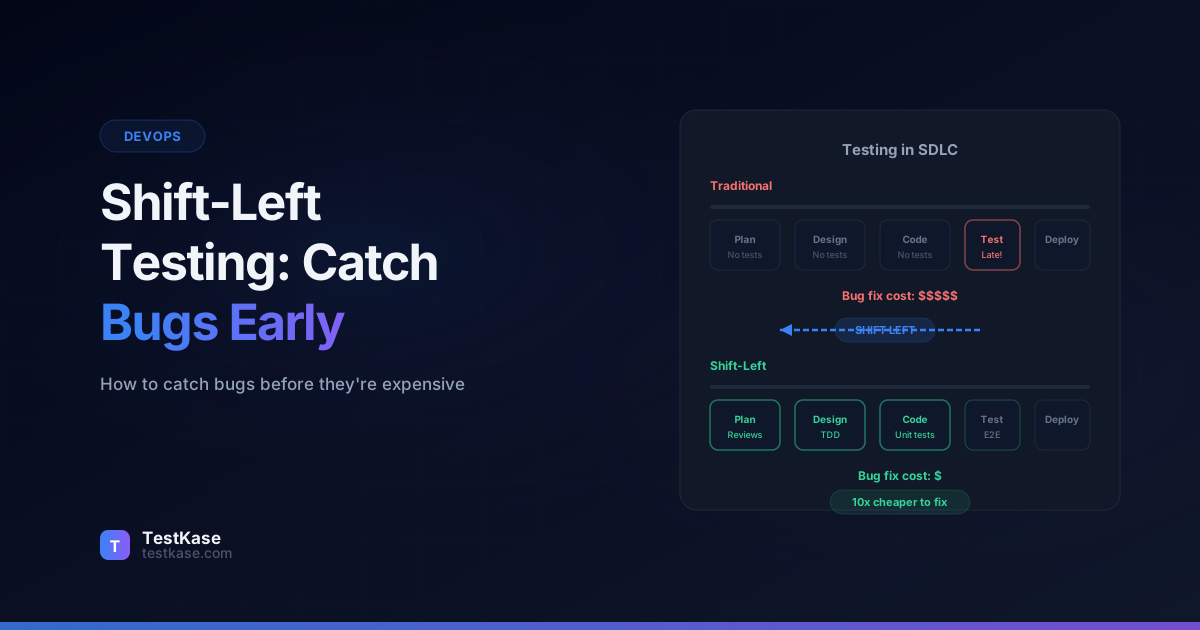
The term comes from visualizing the software development lifecycle as a timeline running left to right: requirements, design, development, testing, deployment, production. Traditional testing clusters on the right side of that timeline. Shift-left means moving testing activities to the left — earlier in the process.
The cost multiplier
The cost to fix a defect increases by approximately 6x at each stage of the development lifecycle. A $100 fix in development becomes a $600 fix in QA, a $3,600 fix in staging, and a $21,600 fix in production. Shift-left testing targets this multiplier by catching defects before they compound.
But shift-left isn't just "write more unit tests." It encompasses a range of practices that inject quality thinking into every phase of development:
- Requirements phase — Review requirements for testability, ambiguity, and completeness
- Design phase — Identify test scenarios before code is written
- Development phase — Unit tests, static analysis, code review with a testing lens
- Integration phase — Automated API and integration tests that run on every commit
- Pre-deployment — Contract tests, smoke tests, and quality gates in CI/CD
The earlier you start, the cheaper the catches. Requirements-phase testing — catching a contradictory requirement before anyone writes code — is the highest-ROI activity in software engineering, yet it's the one most teams skip entirely.
A Real-World Cost Example
Consider a SaaS company building a subscription billing feature. During requirements, the product manager writes: "Users can upgrade or downgrade their plan at any time." This requirement is ambiguous — it doesn't specify whether the change takes effect immediately or at the next billing cycle, whether prorated charges apply, or what happens to feature access during a downgrade.
Here's how the cost escalates depending on when this ambiguity is caught:
| Stage Caught | What Happens | Cost | |---|---|---| | Requirements review | PM clarifies the rule in 15 minutes. Dev and QA start with shared understanding. | ~$50 | | Development | Developer makes an assumption, codes it wrong. Discovers the mismatch during testing, refactors the billing logic. | ~$400 | | QA | Tester finds behavior doesn't match expectations. Bug ticket created, developer context-switches, fixes logic and updates tests. | ~$1,200 | | Production | Customer is charged incorrectly during a downgrade. Support ticket, engineering investigation, hotfix, customer credit, and trust damage. | ~$8,000+ |
The same ambiguity, caught at four different stages, with cost differences spanning two orders of magnitude. This is why shift-left is fundamentally an economic argument, not a process argument.
Implementing Shift-Left: Practical Steps
1. Start with Testable Requirements
A requirement that says "the system should be fast" is untestable. A requirement that says "the search results page loads in under 2 seconds for queries returning up to 500 results" is testable. The difference matters because untestable requirements produce ambiguous code and ambiguous tests.
Before development begins, run your requirements through a testability checklist:
- Can you write a pass/fail test for this requirement?
- Are acceptance criteria specific and measurable?
- Are edge cases identified?
- Are error states defined?
This isn't a QA-only activity. Developers, product managers, and testers should review requirements together — a practice sometimes called the "Three Amigos" meeting. Fifteen minutes of group review can eliminate defects that would otherwise take days to find and fix.
The Three Amigos Meeting in Practice
The Three Amigos meeting brings together three perspectives: product (what should it do?), development (how will it work?), and testing (what could go wrong?). Here's how a productive session works:
- Product manager reads the user story and acceptance criteria aloud. (2 minutes)
- Developer asks clarifying questions about edge cases, error handling, and technical constraints. (5 minutes)
- Tester proposes test scenarios — "What happens when X?" — to probe for gaps. (5 minutes)
- All three agree on the refined acceptance criteria and document them in the ticket. (3 minutes)
A 15-minute meeting, three times per sprint, catches an average of 3-5 requirement defects per sprint — each of which would have cost 10-50x more to fix in later stages.
The key insight is that testers think differently from developers. A developer asks "how do I build this?" while a tester asks "how could this break?" Both perspectives are needed before coding starts, not after.
2. Write Test Cases Before Code
This is the most direct form of shift-left testing: define what "correct" looks like before you build it.
You don't need to adopt full Test-Driven Development (TDD) to get this benefit. Even writing informal test scenarios — "given a user with an expired subscription, when they try to access premium content, they should see the upgrade prompt" — before coding starts gives developers a clearer target.
Test-Driven Development: The Strongest Form of Shift-Left
TDD takes "write tests before code" literally. The cycle is:
- Red — Write a failing test that defines the desired behavior.
- Green — Write the minimum code to make the test pass.
- Refactor — Clean up the code while keeping the test green.
Here's a concrete example for a discount calculation feature:
// Step 1: RED — Write the failing test
describe('calculateDiscount', () => {
  it('applies 10% discount for orders over $100', () => {
    expect(calculateDiscount(150)).toBe(135);
  });

  it('applies no discount for orders under $100', () => {
    expect(calculateDiscount(80)).toBe(80);
  });

  it('applies 10% discount for orders of exactly $100', () => {
    expect(calculateDiscount(100)).toBe(90);
  });

  it('handles zero-dollar orders', () => {
    expect(calculateDiscount(0)).toBe(0);
  });

  it('handles negative amounts gracefully', () => {
    expect(() => calculateDiscount(-50)).toThrow('Invalid order amount');
  });
});
// Step 2: GREEN — Write the minimum implementation
function calculateDiscount(orderAmount) {
  if (orderAmount < 0) throw new Error('Invalid order amount');
  if (orderAmount >= 100) return orderAmount * 0.9;
  return orderAmount;
}
// Step 3: REFACTOR — Clean up if needed (in this case, the code is already clean)
Notice how writing the tests first forced us to consider the boundary condition (exactly $100), the zero case, and negative numbers. Without TDD, developers often implement the happy path first and forget these edge cases until QA finds them.
TDD adoption doesn't have to be all-or-nothing. Many teams use TDD for business logic (calculations, validations, state machines) while using traditional test-after approaches for UI and integration code. Even partial adoption produces measurable quality improvements.
3. Enforce Static Analysis in CI
Static analysis tools catch entire categories of defects without executing code. TypeScript catches type errors. ESLint catches code quality issues. SonarQube catches security vulnerabilities and code smells. These tools run in seconds and catch problems that would take minutes or hours to find through manual testing.
The key is making static analysis non-optional:
# Run static analysis as a pre-commit hook or CI gate
- name: Static Analysis
  run: |
    npm run lint
    npm run typecheck
    npx sonar-scanner
  # This step must pass before tests even run
If a developer's code doesn't pass linting and type checking, it doesn't reach QA. That's shift-left in action — a class of defects eliminated before they ever become bugs.
Static Analysis Tools by Language
Different ecosystems have different tools, but the principle is the same — catch defects before execution:
| Language | Type Checking | Linting | Security | Code Smells | |---|---|---|---|---| | JavaScript/TypeScript | TypeScript | ESLint | npm audit, Snyk | SonarQube | | Python | mypy, pyright | Ruff, pylint | Bandit, Safety | SonarQube | | Java | javac | Checkstyle, PMD | SpotBugs, OWASP | SonarQube | | Go | go vet | golangci-lint | gosec | SonarQube | | Rust | rustc (built-in) | clippy | cargo-audit | SonarQube |
The key pattern is layering: type checking catches type errors, linting catches style and logic issues, security scanning catches vulnerabilities, and code smell detection catches maintainability problems. Together, they form a comprehensive static quality gate.
Pre-Commit Hooks: The Fastest Feedback Loop
The fastest shift-left is preventing bad code from ever being committed. Pre-commit hooks run static analysis before the commit is created:
// .husky/pre-commit (using Husky + lint-staged)
{
  "*.{ts,tsx}": [
    "eslint --fix",
    "prettier --write"
  ],
  "*.{ts,tsx,js,jsx}": [
    "jest --bail --findRelatedTests"
  ]
}
This configuration lints and formats changed files, then runs only the unit tests related to the changed code. The entire process takes 5-15 seconds — fast enough that developers don't bypass it.
The --findRelatedTests flag in Jest is particularly powerful. If you change utils/discount.ts, it only runs the tests that import from discount.ts, not the entire suite. This targeted execution keeps the pre-commit hook fast even as your test suite grows.
4. Build a Fast Unit Test Suite
Unit tests are the foundation of shift-left testing, but they only work if they're fast. A unit test suite that takes 20 minutes to run won't be run on every save. A suite that takes 20 seconds will.
Target these benchmarks:
- Individual unit test: under 50 milliseconds
- Full unit suite: under 2 minutes
- Feedback loop (save to result): under 10 seconds with watch mode
If your unit tests are slow, they're probably not unit tests. Tests that hit databases, call external APIs, or spin up servers are integration tests wearing a unit test costume. Mock external dependencies to keep unit tests fast and isolated.
The Mocking Spectrum
Effective unit testing requires mocking external dependencies, but over-mocking makes tests brittle and meaningless. Here's the spectrum:
// No mocking: This is an integration test, not a unit test
test('creates user in database', async () => {
  const user = await createUser(database, { name: 'Alice' });
  const saved = await database.users.findById(user.id);
  expect(saved.name).toBe('Alice');
});

// Over-mocking: This test is so mocked it proves nothing
test('creates user', () => {
  const mockDb = { users: { create: jest.fn().mockResolvedValue({ id: 1 }) } };
  const mockValidator = { validate: jest.fn().mockReturnValue(true) };
  const mockLogger = { log: jest.fn() };
  createUser(mockDb, mockValidator, mockLogger, { name: 'Alice' });
  expect(mockDb.users.create).toHaveBeenCalledWith({ name: 'Alice' });
});

// Balanced mocking: Tests real logic with external dependencies mocked
test('validates user data before creating', async () => {
  const mockDb = { users: { create: jest.fn().mockResolvedValue({ id: 1 }) } };
  // The validation logic runs for real — only the database is mocked
  await expect(createUser(mockDb, { name: '' }))
    .rejects.toThrow('Name is required');
  expect(mockDb.users.create).not.toHaveBeenCalled();
});
The balanced approach mocks infrastructure (databases, APIs, file systems) while letting business logic run for real. This gives you fast, isolated tests that actually verify behavior.
5. Code Reviews with a Testing Lens
Most code reviews focus on implementation: "Is this the right algorithm? Is the naming clear? Does it follow our conventions?" Shift-left code reviews add a testing dimension:
- Does this change have adequate test coverage?
- Are the tests testing behavior or implementation?
- What edge cases are missing from the tests?
- Could a test failure in this area produce a misleading error message?
The review checklist addition
Add three questions to your code review template: "What new test cases does this PR add?", "What scenarios are NOT covered?", and "If this feature breaks in production, which test would catch it?" These questions force testing thinking into every review.
Code Review Automation for Testing Quality
Automate the mechanical parts of test review so humans can focus on the strategic parts:
# .github/workflows/test-coverage-check.yml
- name: Check test coverage on changed files
  run: |
    npx jest --coverage --changedSince=origin/main
    COVERAGE=$(cat coverage/coverage-summary.json | jq '.total.lines.pct')
    if (( $(echo "$COVERAGE < 80" | bc -l) )); then
      echo "Coverage for changed files is ${COVERAGE}%, below 80% threshold"
      exit 1
    fi
This CI step verifies that new or changed code has at least 80% line coverage. It doesn't replace human judgment about test quality, but it catches the most common gap: code submitted with no tests at all.
6. Integration Testing in CI
Unit tests verify individual components. Integration tests verify that components work together. Both are shift-left practices, but integration tests catch a different class of defect: contract violations, API mismatches, and data flow errors.
// Integration test: verify API contract between frontend and backend
describe('POST /api/projects', () => {
  it('creates a project and returns the expected shape', async () => {
    const response = await request(app)
      .post('/api/projects')
      .send({ name: 'New Project', description: 'Test' })
      .set('Authorization', `Bearer ${testToken}`);

    expect(response.status).toBe(201);
    expect(response.body).toMatchObject({
      id: expect.any(String),
      name: 'New Project',
      description: 'Test',
      createdAt: expect.any(String),
      owner: expect.objectContaining({ id: expect.any(String) }),
    });
  });

  it('returns 400 for missing required fields', async () => {
    const response = await request(app)
      .post('/api/projects')
      .send({})
      .set('Authorization', `Bearer ${testToken}`);

    expect(response.status).toBe(400);
    expect(response.body.errors).toContainEqual(
      expect.objectContaining({ field: 'name', message: expect.any(String) })
    );
  });
});
These tests run on every PR and catch contract violations before they reach QA or production. When the backend changes the response shape, the integration test fails immediately — not three days later when a QA engineer notices the frontend is broken.
Contract Testing for Microservices
For microservices architectures, contract testing is a powerful shift-left technique. Tools like Pact verify that the consumer (frontend) and provider (backend) agree on the API contract:
// Consumer (frontend) test
const interaction = {
  state: 'a project exists',
  uponReceiving: 'a request to get project details',
  withRequest: {
    method: 'GET',
    path: '/api/projects/123',
  },
  willRespondWith: {
    status: 200,
    body: {
      id: '123',
      name: like('Project Name'),
      status: term({ generate: 'active', matcher: 'active|archived' }),
    },
  },
};
The consumer test generates a "pact" (contract) that the provider must satisfy. If the provider changes its API in a way that breaks the contract, the provider's CI pipeline catches it — before the consumer ever sees the breaking change.
Shift-Left vs. Shift-Right: They're Complementary
Shift-right testing — testing in production through canary deployments, feature flags, A/B tests, and observability — isn't the opposite of shift-left. It's the complement.
Shift-left catches known unknowns: the bugs you can anticipate and test for. Shift-right catches unknown unknowns: the issues that only surface under real production traffic, real user behavior, and real data volumes.
A mature testing strategy uses both:
- Shift-left — Unit tests, static analysis, integration tests, test case design, requirements review
- Shift-right — Production monitoring, chaos engineering, feature flag rollouts, real user monitoring
The mistake is treating these as competing philosophies. They address different risk categories. Skip shift-left and you'll ship known bugs. Skip shift-right and you'll miss issues that no test environment can reproduce.
How the Two Strategies Work Together
Here's a concrete example of how shift-left and shift-right complement each other for a feature launch:
Feature: Real-time collaborative editing (like Google Docs)
Shift-left catches:
- Unit tests verify the conflict resolution algorithm handles simultaneous edits correctly.
- Integration tests verify the WebSocket connection protocol between client and server.
- Contract tests verify the message format between the editing service and the persistence layer.
- Static analysis catches potential race conditions in the state management code.
Shift-right catches:
- Canary deployment reveals that the feature causes a 15% increase in WebSocket connections per server, requiring infrastructure scaling.
- Real user monitoring shows that users on mobile networks experience 200ms+ latency in edit synchronization, triggering a UX refinement.
- Feature flags allow rolling the feature out to 10% of users first, catching a rare bug where editing a document with 500+ collaborators causes memory exhaustion.
No amount of pre-production testing would have caught the production-scale issues. No amount of production monitoring would have caught the algorithm bugs. You need both.
The Cultural Shift: Testing Is Everyone's Job
The hardest part of shift-left isn't tooling — it's culture. In traditional organizations, testing is QA's responsibility. Developers write code, QA tests it. Shift-left breaks that division: developers write tests, product managers review testability, and QA focuses on risk analysis and exploratory testing rather than scripted test execution.
This cultural change requires three things:
-
Leadership buy-in — If managers measure developers only on features shipped, not on quality, shift-left won't stick. Quality metrics — defect escape rate, test coverage, time-to-fix — need to be visible and valued.
-
Skill building — Developers need to learn testing techniques. Testers need to learn automation. Product managers need to understand testability. Invest in cross-training.
-
Tooling that supports collaboration — Test cases, requirements, and results need to be visible to everyone, not locked in a QA-only tool.
Measuring Cultural Adoption
How do you know if shift-left is working? Track these leading indicators:
- Developer-authored test percentage — What fraction of test cases and test code is written by developers vs. QA? In a shift-left culture, this should be 50%+ for unit and integration tests.
- Requirements defects caught — How many requirement ambiguities or contradictions are identified before development starts? This number should increase as Three Amigos meetings become habitual.
- Defect find rate by stage — Plot a histogram of where defects are discovered (requirements, development, QA, staging, production). Over time, the distribution should shift left.
- Mean time to detect (MTTD) — How long after a bug is introduced until it's found? Shift-left reduces MTTD from days/weeks to hours/minutes.
Common Mistakes When Shifting Left
-
Equating shift-left with "more unit tests" — Unit tests are part of the picture, but shift-left starts earlier — at requirements and design. If you're only adding unit tests, you're shifting left by one step when you could shift by three.
-
Abandoning right-side testing — Shift-left doesn't mean you stop doing QA, staging tests, or production monitoring. It means you do less repetitive testing on the right because more issues are caught on the left.
-
Making it QA's responsibility — Telling the QA team to "shift left" while developers continue the same process is just moving the QA bottleneck earlier. Shift-left works when the entire team participates.
-
Ignoring feedback loops — Shift-left produces data: which defects are caught at which stage, how long fixes take, where coverage gaps exist. If you're not tracking these metrics, you can't improve. Measure your defect escape rate and track it over time.
-
Over-investing in the wrong test level — Some teams respond to "shift left" by writing thousands of unit tests for UI components while ignoring integration and contract tests. Match your test investment to your risk profile: if most production bugs are API contract violations, invest in integration testing, not more component tests.
-
Expecting overnight results — Shift-left is a cultural change, not a tool installation. The first sprint will feel slower as the team adjusts. By the third sprint, the reduced rework and faster feedback loops start paying dividends. Give it a full quarter before judging the results.
A Shift-Left Adoption Roadmap
If you're starting from a traditional "test at the end" model, here's a phased approach:
Phase 1: Foundation (Weeks 1-4)
- Set up static analysis (linting, type checking) in CI as a blocking gate.
- Add pre-commit hooks for formatting and linting.
- Establish a unit test coverage baseline for your codebase.
- Start Three Amigos meetings for the highest-risk features.
Phase 2: Integration (Weeks 5-8)
- Add integration tests for your most critical API endpoints.
- Introduce code coverage requirements for new code (e.g., 80% line coverage for changed files).
- Train developers on test writing techniques (arrange-act-assert, boundary testing, mocking).
- Begin tracking defect find rate by stage.
Phase 3: Culture (Weeks 9-12)
- Expand Three Amigos to all new features and major changes.
- Add quality metrics to sprint dashboards alongside velocity.
- Encourage developers to write test cases (not just test code) in the test management tool.
- Review the defect stage histogram — are more bugs caught earlier?
Phase 4: Optimization (Ongoing)
- Introduce contract testing for microservice boundaries.
- Implement predictive test selection in CI to keep feedback loops fast as the test suite grows.
- Measure and report shift-left ROI quarterly: defect escape rate, mean time to detect, rework hours saved.
How TestKase Supports Shift-Left Testing
TestKase enables shift-left by making test planning a first-class activity. You can create test cases during sprint planning — before development begins — and link them directly to requirements and user stories. When developers open a Jira ticket, they can see the test cases that need to pass, giving them a concrete definition of "done."
TestKase's AI-powered test case generation takes this further: feed it a requirement, and it produces a structured set of test scenarios covering happy paths, edge cases, and error conditions. Developers and testers start the sprint with a shared understanding of what needs to be tested — not a vague notion that QA will "figure it out later."
With CI/CD integration, TestKase tracks which tests run at which pipeline stage, so you can measure your shift-left progress: are more defects being caught earlier? Are fewer bugs reaching production? The data tells the story.
The platform's reporting features let you generate the exact metrics you need for shift-left measurement: defect find rate by stage, test coverage by requirement, and quality gate pass rates across pipeline stages. These reports make the ROI of shift-left visible to the entire organization — from engineers to executives.
See how TestKase AI accelerates shift-left testingConclusion
Shift-left testing is about economics: find bugs when they're cheap to fix. The practice isn't complicated — review requirements for testability, write test cases before code, enforce static analysis, build fast unit tests, and add testing rigor to code reviews. The hard part is making it a habit across the entire team, not just a QA initiative.
The data is compelling: teams that shift left effectively report 40-60% fewer production defects, 25-35% faster delivery cycles (less rework), and significantly higher developer satisfaction (less firefighting). The investment pays for itself within the first quarter.
Start with one shift: add testability review to your next sprint planning session. Measure what you catch. The ROI will make the case for going further.
Stay up to date with TestKase
Get the latest articles on test management, QA best practices, and product updates delivered to your inbox.
SubscribeShare this article
Related Articles
Critical, Serious, Moderate, Minor: How to Triage Accessibility Issues by Severity
A practical triage policy template — SLAs per severity, ownership across design / engineering / content / QA, and how to share findings cross-team without forwarding PDFs.
Read more →Why Single-Page Accessibility Scans Miss Real Bugs (and What Multi-Page Audits Catch)
Single-URL accessibility scanners miss six entire categories of WCAG violations. Here's what falls through the gap, and how flow-aware audits catch the issues your users actually hit.
Read more →Color Contrast: The #1 Accessibility Violation (and How to Fix It in 30 Minutes)
Color contrast is roughly 38% of every accessibility scan report. Here's the math, the 8 patterns that fail in 90% of apps, and a designer-developer playbook for fixing them without breaking your brand.
Read more →