Testing in Agile Sprints: A Practical Guide for QA Engineers

Testing in Agile Sprints: A Practical Guide for QA Engineers
You just wrapped up sprint planning. The board is loaded with 14 user stories, each one tagged "ready for development." QA gets mentioned exactly once — in a footnote about regression testing on the last day. Sound familiar?
This is the reality for most QA engineers working in agile teams. Despite agile's promise of continuous collaboration, testing often gets crammed into the final 48 hours of a sprint. Developers finish coding on Wednesday, testers scramble Thursday and Friday, bugs get punted to the next sprint, and everyone pretends the process is working.
It doesn't have to be this way. When testing is woven into the fabric of a sprint — not bolted on at the end — teams ship faster, find bugs earlier, and spend less time on rework. According to the World Quality Report, teams that embed QA into sprint activities from day one reduce defect leakage by up to 40%.
This guide covers how to make testing a first-class citizen in your agile sprints, from planning through retrospective.
Why QA Struggles in Agile Sprints
The core tension is straightforward: agile was designed around development velocity. Sprint ceremonies, story points, and burndown charts all center on getting code written and merged. QA fits into that model awkwardly.
Here are the most common friction points:
- The testing bottleneck — Stories pile up as "dev complete" mid-sprint, creating a surge of testing work in the back half
- Incomplete stories — Developers mark stories as done before edge cases are handled, leaving testers to discover gaps
- No time for test design — QA engineers jump straight from one sprint's testing into the next sprint's testing without time to plan
- Automation debt — There's never enough time within a sprint to automate the tests you just wrote manually
- Bug ping-pong — Bugs found late in the sprint bounce between dev and QA, with neither side having enough time to resolve them properly
The cost of late testing
IBM's Systems Sciences Institute found that bugs caught during testing cost 6x more to fix than bugs caught during design. When testing happens only at the end of a sprint, you're paying the maximum price for every defect.
The fix isn't working harder or testing faster. It's restructuring how QA participates in every phase of the sprint.
QA's Role in Sprint Planning
Sprint planning is where QA influence has the highest ROI — and where most QA engineers stay silent. If you're sitting in sprint planning just listening, you're missing your biggest opportunity.
What QA Should Do During Planning
Challenge testability. When a story is proposed, ask: "How will I verify this works?" If the answer is vague, the story isn't ready. Push for acceptance criteria that are specific and measurable.
Here are the questions that surface real problems:
- "What should happen when the user loses internet connection mid-submit?"
- "How do we test this with users who have multiple roles?"
- "This story depends on the payment gateway — is the sandbox environment available?"
- "What's the expected behavior for users in different time zones?"
Each of these questions either reveals a gap in the requirements or confirms that the team has already considered the scenario. Both outcomes are valuable.
Estimate testing effort. Developers estimate development effort. QA should estimate testing effort. A story that takes 3 points to build might take 5 points to test properly if it touches payment processing or user authentication.
Some teams include testing effort in story points. Others track it separately. Either approach works — but ignoring testing effort leads to chronic sprint overcommitment.
A practical estimation framework:
Low test effort (1-2 points):
  - Single-page UI change, no backend logic
  - Config change with well-defined expected behavior
  - Copy/text update with no functional impact

Medium test effort (3-5 points):
  - New feature with 3-5 acceptance criteria
  - API change affecting 2-3 endpoints
  - Workflow change with multiple paths

High test effort (5-8 points):
  - Payment/financial feature (security + compliance testing)
  - Cross-platform feature (browser matrix required)
  - Data migration (before/after validation required)
  - Integration with third-party service (sandbox testing required)
Identify dependencies. QA often spots integration risks that developers miss. "This story changes the checkout flow — have we considered what happens to the existing API consumers?" These cross-cutting concerns are invisible in a single story's scope but become testing headaches when multiple stories interact.
Flag risky stories. Some stories carry more risk than others. A UI label change is low-risk. A database migration is high-risk. QA should advocate for pulling high-risk stories earlier in the sprint so there's time to test thoroughly.
Create a simple risk matrix during planning:
Story            Risk    Reasoning                        Recommendation
USER-501  🟢 Low     Copy change, no logic            Test last day
USER-502  🟡 Medium  New API endpoint                 Test mid-sprint
USER-503  🔴 High    Payment flow change              Start dev day 1
USER-504  🟡 Medium  Search algorithm update          Need perf testing
USER-505  🔴 High    Database schema migration        Needs staging test
Story Grooming for Testability
A well-groomed story makes testing straightforward. Here's what to look for:
When you groom stories with testability in mind, you eliminate an entire category of mid-sprint surprises.
The QA Sprint Planning Checklist
Before sprint planning ends, QA should have answers to these questions for every committed story:
- Are the acceptance criteria specific enough to write test cases from?
- What test data do I need, and does it exist in the test environment?
- Are there dependencies on other stories, services, or environments?
- What's the risk level, and does the sprint schedule give enough time for testing?
- Are there non-functional requirements (performance, security, accessibility) that need testing?
- Does the team's Definition of Done include QA verification?
If you can't answer these questions, the story isn't ready for the sprint — or at minimum, the testing risk should be documented and accepted.
In-Sprint Testing vs. Hardening Sprints
One of the most debated questions in agile QA: should you test within the sprint, or dedicate separate hardening sprints for testing?
In-Sprint Testing
This is the agile purist approach. Every story gets tested within the same sprint it's developed. QA starts writing test cases as soon as stories are groomed, begins exploratory testing as soon as code is deployable, and signs off on stories before sprint end.
Pros:
- Fast feedback loops — bugs are found and fixed while context is fresh
- Stories are truly "done done" at sprint end
- No accumulation of untested work
Cons:
- Requires tight coordination between dev and QA
- Testing can feel rushed if stories are completed late
- Less time for thorough regression testing
Hardening Sprints
Some teams dedicate every 4th or 5th sprint entirely to testing, bug fixing, and technical debt. No new feature development happens during hardening.
Pros:
- Dedicated time for thorough testing
- Opportunity to address accumulated test debt
- Less time pressure on QA
Cons:
- Delays feedback — bugs discovered weeks after code was written
- Developers lose context on old code
- Stakeholders dislike "lost" sprints with no new features
- Creates a false sense that quality is handled "later"
The hybrid approach
The most effective teams use in-sprint testing as the default and schedule hardening activities — not full hardening sprints — at regular intervals. Dedicate 10-15% of each sprint's capacity to regression testing, automation maintenance, and test environment fixes. This prevents the need for dedicated hardening sprints while keeping quality high.
A Day-by-Day Sprint Testing Timeline
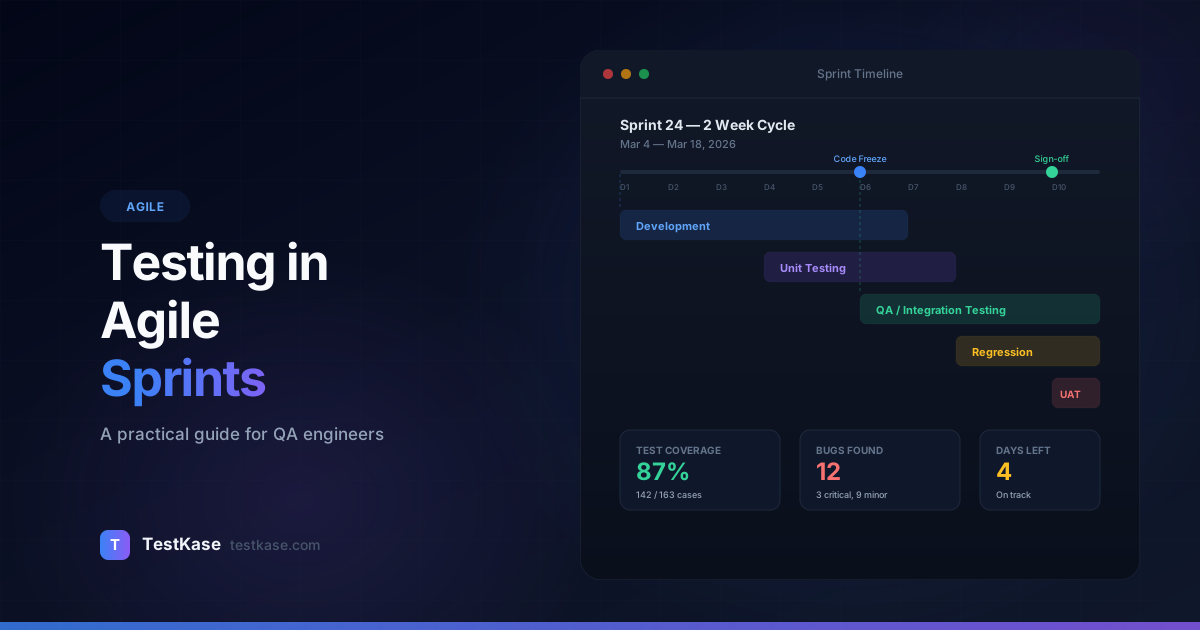
For a standard 2-week (10-day) sprint, here's a realistic timeline for QA activities:
Days 1-2: Preparation
- Write test cases from acceptance criteria (stories groomed in previous sprint)
- Set up test data and verify environment readiness
- Review developer unit test plans for coverage gaps
- Write test charters for exploratory sessions
Days 3-5: Early Testing
- Begin testing stories as developers mark them "ready for QA"
- Run exploratory sessions on completed features
- Flag blockers immediately — don't wait for the daily standup
- Start writing automation for stable features
Days 6-8: Core Testing
- Complete functional testing on all available stories
- Run regression on areas affected by sprint changes
- Verify bug fixes from earlier in the sprint
- Pair with developers on complex bugs to accelerate resolution
Days 9-10: Wrap-Up
- Final regression pass on the full integration
- Update automation suite with new tests
- Document known issues for the sprint review
- Prepare test summary for the retrospective
The key insight: QA work is distributed across all 10 days. If your QA activities are concentrated on days 8-10, you're running a mini-waterfall.
Staggered Story Development
One technique that dramatically improves in-sprint testing: stagger when stories enter development. Instead of all 14 stories starting on day 1, sequence them:
Day 1:  Stories A, B, C start development
Day 3:  Stories A, B, C ready for QA; Stories D, E, F start development
Day 5:  Stories D, E, F ready for QA; Stories G, H start development
Day 7:  Stories G, H ready for QA; Bug fixes and polish
This creates a steady flow of testable work throughout the sprint, eliminating the "everything lands on QA's desk at once" problem. It requires coordination during sprint planning — the team must agree on story sequencing, not just story selection.
Test Case Creation Timing
When should you write test cases — before the sprint, during, or after development is complete? Each approach has trade-offs.
Before development (recommended): Writing test cases from acceptance criteria gives you a testing roadmap before code exists. It also surfaces ambiguities early — if you can't write a clear test case, the requirement isn't clear enough.
Consider this workflow:
1. Story groomed with acceptance criteria    (Sprint N-1)
2. QA writes test cases from criteria        (Sprint N, Day 1-2)
3. Developer reviews test cases              (Sprint N, Day 2)
   → "I didn't realize we needed to handle that edge case"
4. Developer implements with full context     (Sprint N, Day 2-6)
5. QA executes pre-written test cases        (Sprint N, Day 4-8)
6. QA runs exploratory tests beyond cases    (Sprint N, Day 6-9)
Step 3 is where the magic happens. When a developer reads the test cases before writing code, they build with those scenarios in mind — catching issues at the source rather than in the testing phase.
During development: Some teams have QA write test cases in parallel with development. This works well when QA and dev communicate frequently, but risks rework if requirements shift.
After development: This is the most common — and least effective — approach. By the time you're writing test cases after code is complete, you're already behind.
The sweet spot for most teams is writing high-level test cases during grooming, then refining them with specific steps and data during the first days of the sprint.
Automation Within Sprints
"We'll automate it later" is the most expensive phrase in QA. Later never comes, and your manual regression suite grows sprint by sprint until it consumes your entire testing capacity.
What to Automate During a Sprint
Not everything needs automation within the sprint. Focus on:
- Smoke tests for new features — the critical happy path that must always work
- Regression tests for areas affected by the current sprint's changes
- API tests — these are fast to write and provide high coverage per effort
What Can Wait
- UI-heavy exploratory scenarios — automate these after the UI stabilizes
- Edge cases with complex setup — document them as manual tests for now
- One-time verification tests — if you'll never run it again, don't automate it
A reasonable target: automate 20-30% of new test cases within the sprint they're created. That keeps your automation suite growing without overwhelming the sprint.
Practical Sprint Automation Workflow
Here's how to integrate automation into a sprint without it feeling like a separate effort:
Day 1-2: Identify automation candidates from new test cases
  → Mark test cases as "automate this sprint" or "automate later"

Day 3-5: Write automation alongside manual testing
  → After manually executing a test case, write the automated version
  → This works because you just verified the expected behavior

Day 6-8: Add automated tests to CI pipeline
  → New automated tests run on every PR
  → Fix any flaky tests immediately

Day 9-10: Review automation coverage
  → How many new tests were automated?
  → What's the total automation coverage trend?
  → Are there tests from previous sprints that should now be automated?
The key insight is writing automation immediately after manual execution. You've just verified what the correct behavior is — that's the perfect moment to codify it. Waiting days or weeks means re-learning the expected behavior from documentation (which may be incomplete).
Handling Bugs Found Mid-Sprint
You're testing a story on day 6 and find a critical bug. What happens next?
This is where many teams break down. Without a clear bug-handling process, mid-sprint bugs cause chaos — interrupted developers, blown estimates, and stories that stall in "in testing" status.
A Practical Bug Triage Process
Severity 1 (Blocker): Stops the story from being tested further. Developer picks it up immediately. The story doesn't move to "done" until the blocker is fixed and retested.
Severity 2 (Major): Significant issue but testing can continue on other aspects. Developer fixes within the current sprint. Story stays in "in testing" status.
Severity 3 (Minor): Cosmetic or low-impact. Log the bug, link it to the story, and let the product owner decide if it blocks the story's completion or gets added to the backlog.
Severity 4 (Trivial): Typos, minor alignment issues. Fix if there's time, otherwise backlog it.
Don't let bugs pile up in the backlog
Every sprint retrospective should include a review of backlogged bugs. If your bug backlog is growing faster than you're resolving it, that's a sign your Definition of Done needs tightening or your sprint capacity planning isn't accounting for bug-fix time.
The 20% Buffer Rule
Reserve 15-20% of developer capacity in each sprint for bug fixes and unplanned work. Teams that plan for 100% capacity on new features invariably miss their sprint commitments when bugs surface during testing.
Here's how the math works:
Team capacity: 5 developers × 10 days × 6 productive hours = 300 hours
Feature work (80%): 240 hours
Bug fixes + unplanned (20%): 60 hours

Without buffer:
  300 hours planned for features
  15 bugs found during testing × 4 hours average fix time = 60 hours
  Result: 60 hours of feature work slips to next sprint

With buffer:
  240 hours planned for features
  15 bugs found × 4 hours = 60 hours (within budget)
  Result: Sprint commitment met
Teams that consistently use this buffer find that they actually deliver more story points over time because they stop carrying over incomplete work from sprint to sprint.
Communication Protocol for Bugs
Speed matters when bugs are found mid-sprint. Establish a clear communication protocol:
- Immediately: Post in the team's dedicated bug channel (Slack/Teams) with severity, story link, and a one-line description.
- Within 1 hour (for Sev 1-2): Tester and developer have a 5-minute sync to discuss reproduction steps and potential root cause.
- Same day: Developer provides an ETA for the fix. If the ETA extends past the sprint, escalate to scrum master.
- After fix: Tester retests within 4 hours. Don't let verified fixes sit unretested — the developer might need to iterate.
This protocol avoids both extremes: the interrupt-driven approach where every bug stops everything, and the batch approach where bugs pile up and get discussed only at standup.
Managing the QA-Dev Handoff
The handoff from development to testing is the most fragile point in the sprint. A smooth handoff accelerates testing; a rough one wastes hours.
What Developers Should Provide at Handoff
- Deployment confirmation. "This is deployed to staging on build 2.4.31."
- Test focus areas. "I changed the cart calculation logic — please focus on multi-item carts and discount codes."
- Known limitations. "Mobile layout isn't done yet — only test on desktop."
- Test account or data setup. "I created test users admin@test.com and viewer@test.com with the relevant permissions."
What QA Should Provide After Testing
- Test results summary. "8 of 10 test cases passed. 2 failures documented in TC-1042 and TC-1045."
- Bug reports. Filed and linked to the story, with reproduction steps and evidence.
- Exploratory findings. "I also noticed that the loading spinner doesn't dismiss on slow connections — separate from the story but worth noting."
- Sign-off or conditions. "Story is approved for release" or "Story needs re-test after BUG-789 is fixed."
Formalize this handoff as part of your team's workflow. In Jira, this might be a transition from "In Development" to "In QA" that requires the developer to fill in a handoff comment template.
Sprint Retrospective: QA's Voice
The retrospective is your chance to improve the process — but only if you come prepared with data.
Metrics to Bring to Retro
- Bug escape rate — How many bugs made it to production vs. caught in-sprint?
- Testing bottleneck time — How many hours did stories sit in "ready for QA" before testing started?
- Late story completion — How many stories were completed in the last 2 days of the sprint?
- Automation coverage delta — Did your automation suite grow or shrink this sprint?
- Defect injection rate — Which types of stories tend to have the most bugs?
These numbers tell a story that opinions can't. "I felt rushed" is easy to dismiss. "7 of 12 stories entered testing on the last 2 days, and 3 had blocking bugs" demands action.
Actionable Changes to Propose
Don't just raise problems — propose specific experiments. Here are proposals that have worked for other teams:
- "Let's try having developers demo their code to QA before marking stories as ready for testing" — reduces bug density by catching obvious issues earlier.
- "Let's stagger story development so no more than 4 stories enter QA on the same day" — eliminates the testing bottleneck.
- "Let's add a 'testability review' checkbox to our story template" — ensures acceptance criteria are specific before sprint commitment.
- "Let's pair QA and dev on the first 2 bugs of the sprint to establish faster communication patterns" — reduces bug resolution time.
Each proposal should be framed as a time-boxed experiment: "Let's try this for 2 sprints and measure the impact." This makes it low-risk to adopt and easy to revert if it doesn't work.
Common Mistakes QA Teams Make in Agile
Treating sprints as mini-waterfalls. If your sprint has a dev phase followed by a test phase, you're doing waterfall in two-week increments. Testing should overlap with development, not follow it.
Not pushing back on scope. When the product owner adds "just one more story" mid-sprint, QA feels the squeeze the most. Advocate for sustainable scope — you're the one who sees the quality impact of overcommitment.
Skipping test design. Jumping straight into exploratory testing without a plan means you'll miss systematic coverage. Spend time designing test cases even if you're going to execute them informally.
Working in isolation. If your first interaction with a developer is filing a bug report, you're collaborating too late. Pair with developers during implementation to catch issues before they become bugs.
Ignoring non-functional testing. Performance, security, and accessibility testing get deprioritized sprint after sprint. Schedule them explicitly or they'll never happen. A practical approach: assign one non-functional testing activity per sprint on a rotating basis. Sprint 1: performance. Sprint 2: accessibility. Sprint 3: security. This ensures coverage without overwhelming any single sprint.
Not tracking QA metrics. If you can't quantify the impact of late-sprint testing or insufficient automation, you can't make the case for change. Start measuring, even if the numbers are uncomfortable.
Accepting vague acceptance criteria. "User can manage their profile" is not testable. Push back during grooming until criteria are specific: "User can update their display name, email, and avatar. Changes are reflected immediately across the application. Invalid email formats show an error message."
How TestKase Supports Agile Testing
TestKase is built for teams that test within sprints, not after them. Its sprint-aligned test management gives QA engineers the structure they need without slowing down agile delivery.
With TestKase, you can create test cases directly from user stories, organize them by sprint, and track execution status in real time. The platform's AI-powered test generation helps you build comprehensive test suites during grooming — before a single line of code is written.
Test runs map to sprints, giving you instant visibility into what's been tested, what's pending, and where bugs are clustering. When a bug surfaces mid-sprint, you link it directly to the test case and story, creating a traceability chain that makes retrospective analysis effortless.
For teams looking to grow their automation within sprints, TestKase integrates with popular CI/CD pipelines, so your automated test results feed directly into your sprint's quality dashboard.
Start testing smarter in your sprintsConclusion
Agile testing isn't about testing faster — it's about testing smarter. That means QA participating in planning, writing test cases before code exists, testing stories as they're completed rather than in a rush at sprint end, and bringing data to retrospectives.
The teams that do this well don't think of QA as a phase. They think of quality as a thread that runs through every sprint activity, from grooming to demo.
Start with one change next sprint: show up to planning with testability questions. The ripple effects will transform how your team thinks about quality.
Stay up to date with TestKase
Get the latest articles on test management, QA best practices, and product updates delivered to your inbox.
SubscribeShare this article
Related Articles
Critical, Serious, Moderate, Minor: How to Triage Accessibility Issues by Severity
A practical triage policy template — SLAs per severity, ownership across design / engineering / content / QA, and how to share findings cross-team without forwarding PDFs.
Read more →Why Single-Page Accessibility Scans Miss Real Bugs (and What Multi-Page Audits Catch)
Single-URL accessibility scanners miss six entire categories of WCAG violations. Here's what falls through the gap, and how flow-aware audits catch the issues your users actually hit.
Read more →Accessibility Testing in CI/CD: Catching WCAG Issues Before They Ship
Three integration patterns, GitHub Actions / GitLab / CircleCI templates, and a 3-quarter rollout playbook to take an engineering team from zero accessibility in CI to block-on-fail.
Read more →