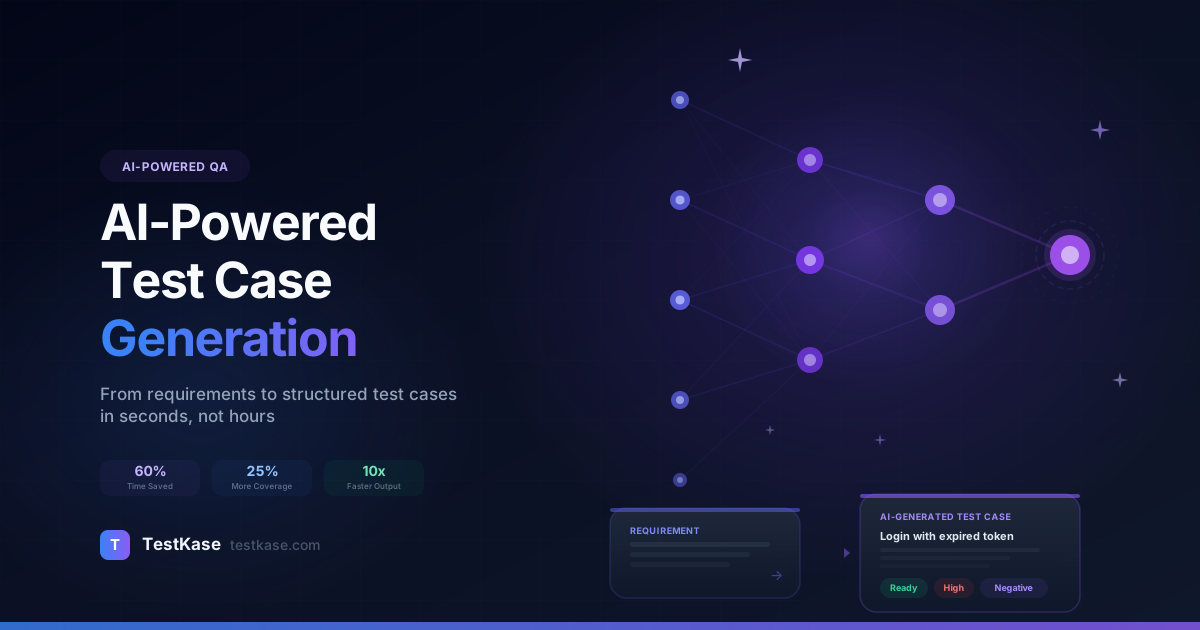
AI-Powered Test Case Generation: The Future of QA

AI-Powered Test Case Generation: The Future of QA
Writing test cases is one of the most time-consuming tasks in QA. For every feature, testers need to think through happy paths, edge cases, error scenarios, and boundary conditions — then document each one with clear steps and expected results.
What if AI could do the heavy lifting?
AI-powered test case generation is rapidly moving from experimental to essential. In this article, we'll explore how it works, where it excels, its limitations, and how tools like TestKase's AI test case generator are making it practical for real QA teams. We'll also walk through real examples, prompt engineering techniques, and a step-by-step adoption roadmap so you can start using AI in your QA process this week.
The Problem with Manual Test Case Writing
Traditional test case creation has several pain points:
- Time-consuming — Writing detailed test cases for a single feature can take hours
- Inconsistent quality — Different testers write at different levels of detail
- Coverage gaps — Humans tend to focus on happy paths and miss edge cases
- Maintenance burden — Test cases become outdated as features evolve
- Knowledge silos — The best test scenarios often live in one person's head
The numbers
Studies show that QA teams spend 30–40% of their time just writing and maintaining test cases. For a team of 6 QA engineers, that's roughly 2 full-time equivalents doing nothing but authoring and updating test documentation. AI can reduce this to a fraction of the effort.
Let's put this in concrete terms. Imagine your team is building a user registration feature with email verification, password complexity rules, and role-based onboarding. A thorough tester would need to cover:
- Happy path registration with valid inputs
- Each validation rule individually (email format, password length, required fields)
- Boundary conditions (password at exactly minimum length, email with unusual TLDs)
- Error handling (duplicate email, server timeout, expired verification link)
- Security scenarios (SQL injection in fields, XSS attempts, brute force protection)
- Accessibility (screen reader compatibility, keyboard navigation)
- Cross-browser behavior
That's easily 25-40 test cases for one feature. At 10-15 minutes per well-written test case, you're looking at 4-10 hours of work. Multiply that by the 8-12 features in a typical sprint, and test case writing becomes a full-time job.
The Hidden Cost of Inconsistency
Beyond raw time, inconsistency between testers creates a secondary problem. When one QA engineer writes test cases with three detailed steps and another writes them with twelve granular steps, the test suite becomes unpredictable. New team members don't know which style to follow. Test execution times vary wildly. And when someone needs to update a test case written by a colleague who left six months ago, they spend more time deciphering the intent than making the change.
A 2025 study by Capgemini found that organizations with inconsistent test documentation spend 35% more time on test maintenance than those with standardized formats. AI eliminates this variation by producing uniformly structured output every time.
How AI Test Case Generation Works
Modern AI test generation uses large language models (LLMs) combined with structured QA knowledge to produce test cases. Here's the typical flow:
1. Input: Requirements or User Stories
You provide the AI with context — a user story, requirement document, feature description, or even a Jira ticket. The more specific the input, the better the output.
Example input:
"As a user, I can reset my password by entering my email address. The system sends a reset link that expires in 24 hours. The link can only be used once."
2. Analysis: Understanding the Feature
The AI parses the requirement and identifies:
- Functional scenarios — The happy path (successful reset)
- Negative scenarios — Invalid email, expired link, already-used link
- Boundary conditions — Link expiry at exactly 24 hours
- Security considerations — Rate limiting, email enumeration
- Implicit requirements — Password complexity on the new password, confirmation field matching
This last point is crucial. Experienced AI models identify requirements that are implied but not stated. A password reset feature implicitly requires a new password form, which implies password validation rules, which implies error messages for invalid passwords. Good AI catches these implicit chains.
3. Output: Structured Test Cases
The AI generates test cases with:
- Clear titles
- Preconditions
- Step-by-step instructions
- Expected results
- Priority and category tags
Understanding the AI Pipeline Under the Hood
Most AI test generation tools don't just pass your requirement straight to a generic LLM. They use a multi-stage pipeline:
- Preprocessing — The input is cleaned, structured, and enriched with metadata (feature type, domain, platform).
- Retrieval-Augmented Generation (RAG) — The system retrieves relevant patterns from a knowledge base of testing best practices, common edge cases for similar features, and your team's historical test cases.
- Generation — The LLM produces test cases using the enriched context, following a structured output schema.
- Post-processing — Generated cases are deduplicated, prioritized, and formatted to match your team's template.
This pipeline is why specialized QA AI tools consistently outperform generic chatbots for test case generation. The retrieval step injects domain-specific testing knowledge that a general-purpose model doesn't have.
The Art of Prompting for Better Test Cases
The quality of AI-generated test cases depends heavily on how you frame the request. This is where prompt engineering meets QA expertise.
Bad Prompt vs. Good Prompt
Bad prompt:
"Write test cases for the shopping cart."
This gives the AI almost nothing to work with. Which shopping cart? What features does it have? What are the business rules?
Good prompt:
"Write test cases for an e-commerce shopping cart with the following behavior:
- Users can add items, update quantities (1-99), and remove items
- Cart persists across browser sessions for logged-in users
- Guest users lose their cart after 24 hours of inactivity
- Discount codes can be applied (one per order, minimum $50 order)
- Shipping is free for orders over $100
- Cart shows real-time inventory (items become unavailable if stock drops to 0)
- Maximum 20 unique items per cart
Cover positive, negative, boundary, and concurrency scenarios."
This prompt gives the AI enough context to generate meaningful, specific test cases.
Prompt Engineering Techniques for QA
Here are proven techniques to get better results:
1. Specify the output format
Generate test cases in the following format:
- Title: [descriptive title]
- Priority: [High/Medium/Low]
- Preconditions: [what must be true before the test]
- Steps: [numbered list of actions]
- Expected Result: [what should happen]
2. Include user roles and permissions
The system has three roles: Admin, Editor, and Viewer.
- Admins can create, edit, and delete all resources
- Editors can create and edit their own resources
- Viewers can only read resources
Generate test cases that cover permission boundaries for each role.
3. Ask for specific test types
Generate the following types of test cases:
- 5 happy path scenarios
- 5 negative/error scenarios
- 3 boundary condition tests
- 3 security-related tests
- 2 performance considerations
4. Provide error messages and validation rules
Validation rules:
- Email must contain @ and a valid domain
- Password: minimum 8 characters, at least one uppercase, one number, one special character
- Username: 3-30 characters, alphanumeric and underscores only

Error messages:
- Invalid email: "Please enter a valid email address"
- Weak password: "Password must be at least 8 characters with one uppercase letter, one number, and one special character"
The more specific your validation rules and expected error messages, the more precise the test cases will be.
Advanced Prompting: Chain-of-Thought for Complex Features
For features with intricate business logic, a single prompt often isn't enough. Use chain-of-thought prompting to guide the AI through multiple layers:
Step 1: List all the user roles that interact with the billing module.
Step 2: For each role, identify what actions they can and cannot perform.
Step 3: For each action, identify the happy path, one negative scenario,
        and one boundary condition.
Step 4: Format each scenario as a structured test case with title,
        preconditions, steps, and expected result.
This technique produces more thorough results because it forces the AI to think systematically rather than generating test cases from a surface-level reading of the requirement.
Iterative Refinement: The Review-and-Regenerate Loop
The best results come from treating AI generation as an iterative process, not a one-shot activity:
- Generate — Create the initial set of test cases from the requirement.
- Review — Have a senior tester scan the output for gaps, inaccuracies, and low-value cases.
- Refine — Feed the AI feedback: "You missed concurrent editing scenarios. Add 3 test cases covering what happens when two users edit the same record simultaneously."
- Finalize — Approve the refined set and add to your test suite.
Teams that use this loop consistently report 85-95% usability rates for AI-generated test cases, compared to 60-70% for single-pass generation.
Where AI Excels in Test Generation
Edge Case Discovery
AI models have been trained on millions of software scenarios. They're remarkably good at suggesting edge cases that humans overlook — like boundary conditions, concurrency issues, and unusual input combinations.
For example, given a date range picker, AI will typically generate test cases for:
- Start date after end date
- Same start and end date
- Date range spanning a leap year boundary (Feb 28 to Mar 1)
- Date range spanning a DST transition
- Date range spanning a year boundary (Dec 31 to Jan 1)
- Maximum possible date range
- Dates in the far past or far future
Many of these — especially DST transitions and leap year boundaries — are the kinds of edge cases that human testers frequently miss but that cause real production bugs.
Here's a concrete data point: a fintech company using AI-generated test cases for their date-based transaction reporting discovered a DST-related bug that had been in production for two years. The bug caused transactions at 2:00 AM on daylight saving transition days to be assigned to the wrong reporting period. No manual tester had ever thought to check that scenario.
Consistency
Every AI-generated test case follows the same structure and level of detail. No more variation between team members. When one tester writes "click the button" and another writes "locate the submit button labeled 'Save Changes' in the lower right corner of the form, verify it is enabled, and click it," the inconsistency makes the test suite harder to maintain and execute.
AI produces uniform output every time, which makes test cases easier to review, execute, and maintain.
Speed
What takes a human tester 2–3 hours can be generated in seconds. The tester's role shifts from writing to reviewing and refining — a much higher-leverage activity.
Here's a realistic time comparison for a medium-complexity feature (user profile management with 8 fields, validation rules, and role-based permissions):
| Activity | Manual | AI-Assisted | |----------|--------|-------------| | Test case writing | 3-4 hours | 5 minutes (generation) | | Review and refinement | N/A | 45-60 minutes | | Total time | 3-4 hours | 50-65 minutes | | Coverage quality | Variable | Consistently thorough |
Coverage Analysis
AI can compare generated test cases against requirements and identify gaps — requirements without corresponding tests or scenarios that haven't been covered.
This is particularly powerful in regulated environments where traceability matrices are required. AI can map each requirement to its test cases and flag any requirement that lacks sufficient coverage.
Regression Test Generation
When a feature changes, AI can analyze the diff between the old and new requirements and generate test cases specifically for the changed behavior. This is a game-changer for maintenance — instead of manually reviewing hundreds of existing test cases after a feature update, AI identifies exactly which scenarios need new or modified test cases.
For example, if your payment feature adds support for Apple Pay alongside existing credit card and PayPal options, AI can generate test cases that specifically cover:
- Apple Pay-specific flows (biometric authentication, device compatibility)
- Interactions between Apple Pay and existing features (refunds, recurring billing)
- Migration scenarios (users switching from card to Apple Pay)
This targeted generation avoids the "boil the ocean" approach of regenerating the entire test suite for every change.
AI as a co-pilot
The best approach is to use AI as a starting point, not a replacement. Generate test cases with AI, then have experienced testers review, refine, and add domain-specific scenarios. Think of it as AI writing the first draft and humans editing it to perfection.
Limitations to Be Aware Of
AI-generated test cases are powerful but not infallible. Understanding the limitations helps you use AI effectively rather than blindly trusting its output.
Domain-Specific Knowledge
AI may not understand your business rules, compliance requirements, or industry-specific testing needs without additional context.
For example, if you're building a healthcare application, AI won't automatically know about HIPAA requirements for data handling, audit logging, or consent management. You need to provide this context explicitly — or have a domain expert review the generated tests.
Similarly, financial applications have domain-specific rules around decimal precision, rounding behavior, currency conversion, and regulatory reporting that AI won't infer from a generic feature description. A test case that validates "total equals item price times quantity" might miss that your system rounds to 4 decimal places for intermediate calculations but 2 decimal places for display — a distinction that matters for financial accuracy.
Over-Generation
AI can produce too many test cases, including low-value ones. A request for "test cases for a search feature" might yield 50 test cases when 15 well-chosen ones would provide 95% of the coverage.
Teams need to prioritize and prune. Not every AI-generated test case needs to be added to the suite. Treat AI output as a menu of options, not a mandatory list.
A practical heuristic: after AI generates test cases, rank them by risk and coverage contribution. The top 60-70% of cases typically cover 90-95% of the meaningful scenarios. The remaining cases are often edge cases of edge cases that are unlikely to surface real bugs.
False Confidence
AI-generated tests still need human review. A test case that looks reasonable might miss subtle logic or produce incorrect expected results.
Here's a real example: AI generates a test case for currency conversion that says "verify that $100 USD converts to approximately 85 EUR." That expected result was accurate in 2024 but might be wrong today. AI doesn't always know what "correct" looks like for your specific system.
Another common pitfall is AI generating test cases with logically correct steps but physically impossible sequences. For instance, a test case might say "upload a 10 GB file and verify the upload completes within 5 seconds" — technically a valid performance test, but one that no real network could satisfy. Human review catches these practical impossibilities.
Integration Context
AI doesn't automatically know how your system integrates with third-party services, databases, or infrastructure. Integration test scenarios often need human input.
If your payment system uses Stripe in test mode, your authentication uses Auth0, and your email delivery uses SendGrid, AI won't know the specific behaviors, rate limits, and failure modes of each service. Integration test cases need input from engineers who understand the system architecture.
Hallucinated Steps
AI can generate test steps that reference UI elements, API endpoints, or features that don't exist in your application. Always validate generated test cases against the actual system before adding them to your suite.
This is especially common when AI generates test cases for features that are still in design. The AI might assume a "Cancel" button exists on a form when your design uses browser back navigation, or assume a confirmation modal appears when your flow uses inline success messages.
AI in Test Management: Beyond Generation
AI isn't just useful for creating new test cases. Modern AI-powered test management tools also help with:
Test Case Maintenance
When requirements change, AI can suggest which test cases need updating and propose modifications. Instead of manually reviewing 200 test cases after a feature redesign, AI can identify the 12 that reference the changed functionality and suggest updated steps.
Flaky Test Detection
AI can analyze test execution patterns to identify flaky tests — tests that pass and fail intermittently without code changes. By examining execution history, environment data, and timing patterns, AI can distinguish between genuine flakiness and tests that fail due to environment-specific issues.
In practice, AI-powered flaky test detection works by analyzing three signals:
- Execution variance — Does this test alternate between pass and fail across consecutive runs with no code changes?
- Timing correlation — Do failures cluster at specific times (suggesting resource contention or external dependency issues)?
- Environment correlation — Do failures occur on specific runners, browsers, or OS versions?
By combining these signals, AI can classify each flaky test and recommend the appropriate fix: retry logic for timing issues, environment pinning for runner-specific failures, or test refactoring for genuine instability.
Smart Test Selection
For large test suites, AI can recommend which tests to run based on the code changes in a PR, reducing cycle time without sacrificing coverage. If a PR only changes the payment module, there's no need to run 3,000 tests — the 150 tests covering payment, checkout, and billing are sufficient.
This is sometimes called "predictive test selection" and can reduce CI/CD pipeline time by 60-80% while maintaining the same defect detection rate.
Google's internal research on predictive test selection showed that running just 5-10% of affected tests caught 95% of regressions while reducing CI time from 45 minutes to under 5 minutes. While most teams won't match Google's scale, the principle applies universally: smart selection beats brute-force execution.
Test Summary and Reporting
AI can analyze test results across cycles and generate natural-language summaries for stakeholders — highlighting trends, risks, and areas of concern.
Instead of stakeholders staring at a dashboard of numbers, they get:
"This sprint's test cycle shows a 94% pass rate, down from 97% last sprint. The decline is concentrated in the payment module (3 new failures) and the user dashboard (2 new failures). Two of the payment failures are related to the Stripe API upgrade in PR #2847. The dashboard failures appear to be CSS regression from the design system update. Recommend blocking the release until the payment failures are resolved; dashboard issues are cosmetic and low-risk."
That's a report a product manager can act on without needing to understand testing terminology.
Duplicate Test Case Detection
Over time, test suites accumulate duplicates — especially when multiple testers create cases for the same feature independently, or when new test cases are added without checking for existing coverage. AI can analyze your entire test library semantically (not just by title matching) and identify cases that test the same behavior with different wording.
A team at a mid-size SaaS company ran AI duplicate detection on their 2,400-test-case library and found 340 effective duplicates — 14% of their suite. Removing them saved 8 hours per regression cycle in execution time alone.
How TestKase Uses AI
TestKase integrates AI throughout the test management workflow:
AI Test Case Generation
Paste a requirement, user story, or feature description and TestKase generates structured test cases instantly. Each generated test includes:
- Title, steps, and expected results
- Priority classification
- Suggested tags for organization
- Preconditions and test data
Here's what the workflow looks like in practice:
- You paste a Jira ticket description or user story into the AI generation panel
- TestKase analyzes the requirement and generates 10-20 structured test cases
- You review the generated cases, adjust priorities, refine steps, and remove any that aren't relevant
- Approved test cases are added to your test suite with a single click
- The test cases are automatically tagged and organized based on the requirement context
AI-Powered Insights
TestKase's AI analyzes your test suite to:
- Identify coverage gaps across modules
- Suggest missing negative and edge case scenarios
- Highlight duplicate or redundant test cases
- Detect test cases that haven't been updated in over 6 months
Natural Language Search
Search your test library using plain English. Ask "show me all login-related tests" instead of filtering by exact tags. The semantic search understands intent, so "authentication tests" and "login and signup test cases" return the same relevant results.
Real results
Teams using TestKase's AI features report a 60% reduction in test case writing time and a 25% improvement in test coverage within the first month.
Real-World Example: AI-Generating Tests for a SaaS Feature
Let's walk through a complete example. Your team is building a team invitation feature:
Requirement:
"Team admins can invite new members by email. Invitations expire after 7 days. Invited users see a sign-up form pre-filled with their email. Admins can resend or revoke pending invitations. Teams have a maximum of 50 members on the free plan and unlimited on paid plans."
AI-generated test cases (after review and refinement):
- Admin invites a new member with valid email — Verify invitation email is sent, pending invitation appears in admin panel, invited user can sign up via the link
- Admin invites an existing member — Verify appropriate error message ("This user is already a member of this team")
- Invitation link expires after 7 days — Verify clicking an expired link shows "This invitation has expired" message with option to request a new one
- Admin resends a pending invitation — Verify new email is sent, expiration resets to 7 days from resend time
- Admin revokes a pending invitation — Verify the invitation link no longer works, pending invitation removed from admin panel
- Free plan team at 50-member limit — Verify admin sees "Team member limit reached" when trying to invite member #51, with upgrade prompt
- Paid plan team has no member limit — Verify admin can invite member #51 and beyond
- Invited user signs up with pre-filled email — Verify email field is pre-populated and read-only, user completes remaining profile fields
- Invited user changes the pre-filled email — Verify this is not allowed (email field is locked to the invited address)
- Multiple pending invitations for same email — Verify system prevents duplicate invitations, shows "Invitation already pending" message
- Admin invites user with invalid email format — Verify validation error before invitation is sent
- Invitation accepted by user on different browser/device — Verify the link works regardless of where it's opened
A human tester would likely have written 5-7 of these. AI produced 12, including the member limit boundary test, the duplicate invitation check, and the cross-device scenario — all of which are real-world bug sources.
What the AI Missed (And Why Human Review Matters)
Even with 12 solid test cases, a senior tester reviewing this list would likely add:
- Rate limiting on invitations — What happens if an admin sends 100 invitations in 1 minute? Is there a rate limit?
- Invitation email deliverability — Does the invitation email land in spam folders? Is the sender domain configured with SPF/DKIM?
- Concurrent invitation and sign-up — What if a user clicks the invitation link at the exact moment the admin revokes it?
- Internationalization — Does the invitation email render correctly for users with non-Latin email addresses or names?
These scenarios require knowledge of your specific infrastructure, your email provider's behavior, and your security policies — context that AI doesn't have. This is why the human review step isn't optional.
Real-World Case Study: E-Commerce Platform Migration
To illustrate AI test generation at scale, consider this real scenario. An e-commerce platform was migrating from a monolithic checkout to a microservices architecture. The checkout flow had 180 existing test cases, but the migration changed the underlying APIs, data flow, and error handling.
The QA team faced a choice: manually review and rewrite 180 test cases (estimated 2 weeks of work) or use AI-assisted generation with the new architecture's specifications.
They chose the AI approach:
- Day 1 — Fed the new API documentation, microservice contracts, and migration notes into the AI generation tool.
- Day 1-2 — AI generated 210 test cases covering the new architecture, including 45 integration scenarios between microservices that didn't exist in the monolith.
- Day 2-3 — Senior testers reviewed the output, removed 30 irrelevant cases, refined 50 with domain-specific details, and added 15 migration-specific scenarios (data consistency between old and new systems).
- Day 3-4 — Final suite of 195 test cases was imported into the test management tool, tagged, and prioritized.
Total time: 4 days instead of 10. Coverage increased from 72% (the old suite had drifted) to 91%. The team caught 3 critical bugs during the first test cycle that would have reached production under the old manual approach.
Getting Started with AI-Powered QA
If you're new to AI in testing, here's a practical roadmap:
Week 1-2: Experiment
- Start small — Use AI to generate test cases for one feature or module
- Compare output — Generate AI test cases and compare them against what your team would have written manually
- Measure quality — How many AI-generated cases are usable as-is? How many need editing? How many are irrelevant?
Week 3-4: Refine
- Review rigorously — Have senior testers review AI output before adding to your suite
- Iterate on prompts — Better input produces better output; refine your requirement descriptions
- Build prompt templates — Create reusable prompt templates for common feature types (CRUD operations, authentication flows, API endpoints)
Month 2: Scale
- Measure impact — Track time saved, coverage improvements, and defect escape rates
- Train the team — Share prompt engineering best practices and successful examples
- Scale gradually — Expand AI-assisted generation across your product as confidence grows
Month 3+: Optimize
- Automate the pipeline — Trigger AI test generation when new Jira tickets are created or requirements are updated
- Build feedback loops — Track which AI-generated tests catch real bugs and feed that data back into your prompt templates
- Integrate with CI/CD — Use AI-powered smart test selection to optimize pipeline runtime
Measuring the ROI of AI Test Generation
To justify the investment, track these metrics before and after adopting AI:
Beyond the Numbers: Qualitative Benefits
ROI isn't purely quantitative. Teams that adopt AI test generation consistently report:
- Reduced burnout — QA engineers spend less time on repetitive documentation and more time on intellectually challenging exploratory testing.
- Faster onboarding — New team members generate their first test cases on day one using AI, instead of spending weeks learning the team's format and standards.
- Better conversations — When AI generates a baseline set of test cases, sprint planning discussions shift from "what should we test?" to "what did the AI miss?" — a more productive starting point.
- Improved developer-QA collaboration — Developers can generate test cases from their own feature descriptions, giving QA a head start and creating a shared language around quality.
The Future: Where AI Testing Is Headed
AI test case generation is evolving rapidly. Here's what the next 12-18 months will bring:
Multimodal input — AI will generate test cases from UI mockups, Figma designs, and video walkthroughs, not just text requirements. Point AI at a design file and get test cases that reference specific UI elements and interactions.
Self-healing test cases — When a feature changes, AI will automatically update affected test cases based on the code diff, reducing the manual maintenance burden further.
Context-aware generation — AI will learn your codebase, your bug history, and your users' behavior patterns to generate test cases that target your application's actual weak spots, not just generic scenarios.
Natural language test execution — Instead of writing automation scripts, testers will describe test scenarios in plain English, and AI will translate them into executable test code for Playwright, Cypress, or Selenium.
These advances won't eliminate the need for human QA engineers — they'll elevate the role. Testers will become quality strategists who direct AI tools, review AI output, and focus on the high-judgment activities that machines can't replicate: usability evaluation, exploratory testing, and risk assessment.
Conclusion
AI-powered test case generation isn't replacing QA engineers — it's amplifying them. By handling the repetitive, time-consuming parts of test creation, AI frees testers to focus on what humans do best: exploratory testing, usability evaluation, and strategic quality thinking.
The technology is mature enough for production use today. The teams that adopt it now will build faster, catch more bugs, and spend their human expertise where it matters most — on the testing problems that actually require human judgment.
The tools are ready. The question is whether your team is leveraging them yet.
Start Free with TestKase →Stay up to date with TestKase
Get the latest articles on test management, QA best practices, and product updates delivered to your inbox.
SubscribeShare this article
Related Articles
Critical, Serious, Moderate, Minor: How to Triage Accessibility Issues by Severity
A practical triage policy template — SLAs per severity, ownership across design / engineering / content / QA, and how to share findings cross-team without forwarding PDFs.
Read more →Why Single-Page Accessibility Scans Miss Real Bugs (and What Multi-Page Audits Catch)
Single-URL accessibility scanners miss six entire categories of WCAG violations. Here's what falls through the gap, and how flow-aware audits catch the issues your users actually hit.
Read more →Accessibility Testing in CI/CD: Catching WCAG Issues Before They Ship
Three integration patterns, GitHub Actions / GitLab / CircleCI templates, and a 3-quarter rollout playbook to take an engineering team from zero accessibility in CI to block-on-fail.
Read more →