Point your RemoteWebDriver at a grid you don't run
Real Chrome, Edge and Firefox on macOS and Windows, plus Safari on macOS — all behind one W3C WebDriver endpoint. Your suite, your language, no grid to keep alive.
Free device-minutes · W3C WebDriver · no SDK lock-in
Your suite
RemoteWebDriver
hub.testkase.com/wd/hub
macOS


Windows
The tests are yours. The grid is the part you never wanted.
A browser shipped a new build overnight, a driver no longer matches, and a suite that was green yesterday is red for a reason that isn't your code. Somebody has to own the nodes, the drivers, the browser updates, and the Mac that keeps Safari alive. Here, nobody on your team does.
One endpoint. The whole grid, handed over.
Point a RemoteWebDriver at the endpoint and the upkeep disappears.
No nodes to provision
Real browsers on real macOS and Windows machines, ready the moment your suite connects.
No drivers to chase
Browsers and their drivers stay matched and current on our side, release after release.
Real Safari on macOS
A first-class WebDriver target — the one most self-hosted grids quietly skip.
Any WebDriver language
Java, Python, JavaScript, C# or Ruby — plain W3C WebDriver, no SDK to adopt.
Parallel from any CI
Fan tests across threads bounded by your plan, not by hardware you babysit.
A full grid queues, never fails
When every node is busy, your session waits in a ranked queue instead of erroring out.
Bring the language your suite already speaks
Real browsers
chromeedgefirefoxsafariYour language
Swap the URL. Keep the suite.
Moving off a self-hosted grid is one line: point your RemoteWebDriver at the TestKase endpoint. The same W3C capabilities, the same tests — the vendor block just becomes testkase:options.
http://grid.internal:4444/wd/hubhttps://<user>:<accessKey>@hub.testkase.com/wd/hubEverything a red build needs, already captured
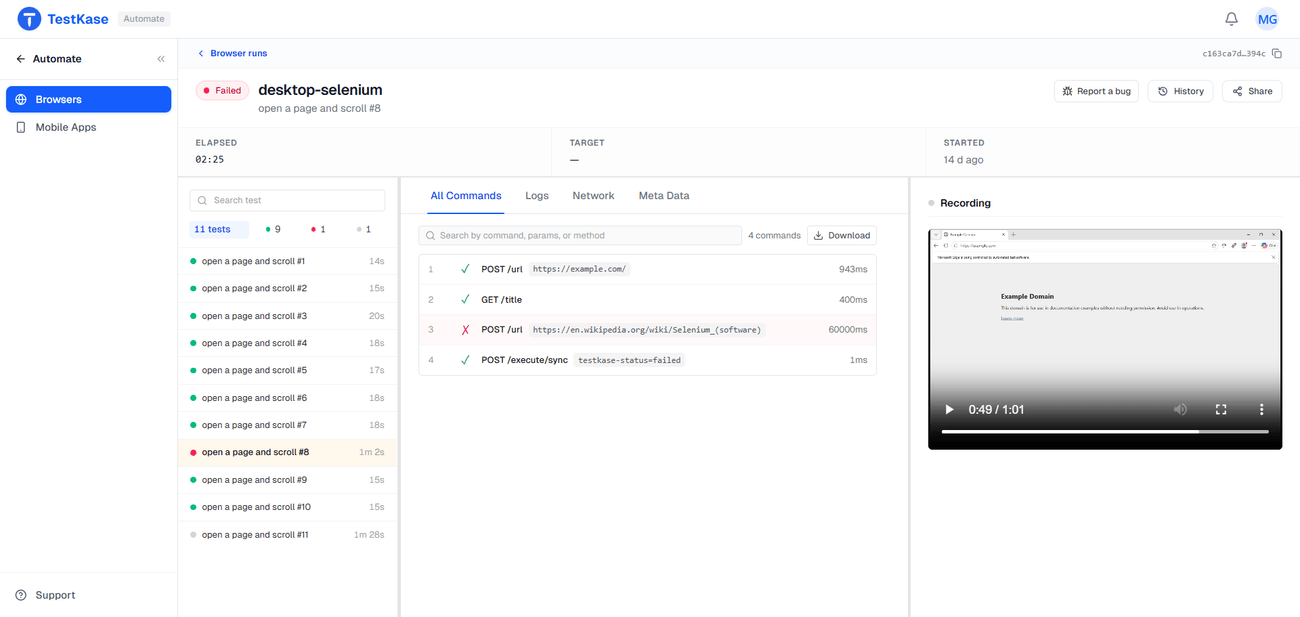
No grid node to SSH into after the fact. Every run lands on its own page with the evidence attached — watch it live or open it later.
- Session video. A full recording of every run, ready to scrub the moment a test fails.
- Console, network and driver logs. Every command and request for the run, captured without a line added to your tests.
- A shareable session page. Status, browser, OS and every artifact on one link — a red build is one click from proof.
Frequently asked questions
Yes — TestKase is a hosted alternative to running your own Selenium Grid. Point a RemoteWebDriver at one W3C WebDriver endpoint instead of provisioning nodes and chasing drivers, and when every node is busy your session waits in a ranked queue rather than failing. Your existing tests, language and framework stay exactly as they are.
No. TestKase speaks standard W3C WebDriver, so your existing Selenium tests, assertions and framework stay exactly as they are. You change only the endpoint your suite connects to.
Any language with an official Selenium binding — Java, Python, JavaScript, C#, Ruby and more. There is no proprietary SDK to adopt; it is plain W3C WebDriver.
Chrome, Edge and Firefox on real macOS and Windows machines, plus Safari on macOS. Pick the browser with the standard browserName capability, and the machine with platformName — which accepts macOS, macOS 15, macOS Sequoia, macOS 26, macOS Tahoe, Windows 10 and Windows 11. This is browser Selenium only: there is no mobile or native-app automation here.
Point a RemoteWebDriver at https://hub.testkase.com/wd/hub and pass a standard browserName plus a testkase:options block with platformName, build and name. Your access key is the password half of the URL's basic auth; if your client strips the userinfo out of the URL, pass it as testkase:options.accessKey instead.
A full session video, the console, network and WebDriver command logs, a live view of the running browser, and a shareable session detail page with every artifact — all captured on our side, with nothing added to your test code. Console and network come from CDP on Chrome and Edge, and from BiDi on Firefox.
No — and that is the one caveat worth knowing. Safari is a supported, working target on current macOS, but its automation protocol exposes neither console nor network data to anyone, on macOS or iOS, so no vendor can provide them. Video, driver logs and the full command list all still work. The practical pattern: reproduce the behaviour in Safari, then run the same scenario on Chrome to investigate the cause.
Your session waits in a ranked queue rather than failing. New sessions wait up to a default of three minutes for a node, and you can raise that wait if your pipeline prefers to hold longer.
Parallel threads are bounded by your plan. The free tier has no thread limit — its 15 free device-minutes are the only limit, and they can be spent across as many threads as they cover. Paid plans run 1 to 20 threads bought self-serve, and a negotiated enterprise contract can go higher.
Yes — every account gets free device-minutes to try Selenium on real browsers, no credit card required.
Run Selenium on real browsers, free
Point your existing WebDriver suite at the endpoint and go — no credit card required.